

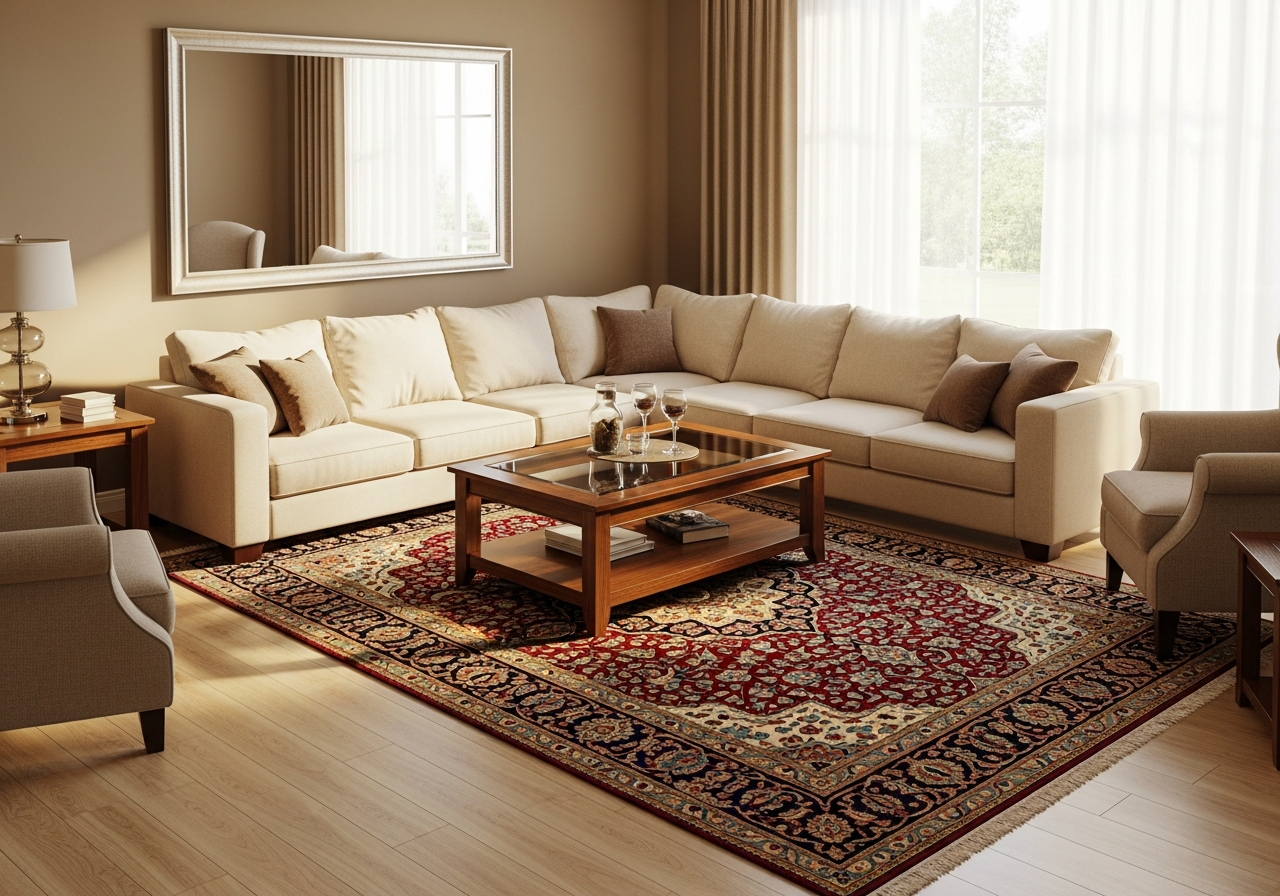
Walking into a living room that feels cramped and awkward often has nothing to do with the room’s actual size. The culprit? A poorly placed rug that’s chopping up your floor space and making everything look disconnected.
Your rug does more heavy lifting than you think. It anchors furniture, defines zones, and creates visual flow. Get the placement wrong, and suddenly your spacious living room feels like a cluttered shoebox.
The Biggest Rug Mistake That Shrinks Your Room
Here’s what most people get wrong: they buy a rug that’s too small and float it in the middle of the room like a sad little island.
This creates multiple visual breaks in your floor space. Instead of one cohesive area, your eye sees fragmented sections. Small rug, big furniture grouped around it, bare floor everywhere else. The result? Your room looks chopped up and smaller than it actually is.
The fix is counterintuitive. A larger rug that extends under your furniture makes the room feel bigger, not smaller.
Size Matters: Choosing the Right Rug Dimensions
Forget those 5×7 rugs unless you’re working with a tiny apartment. For most living rooms, you need to think bigger.
For average living rooms (12×15 feet or similar):
- 8×10 feet is your starting point.
- 9×12 feet works beautifully for most setups.
- 10×14 feet if you have a larger space.
For spacious living rooms (15×18 feet and up):
- 9×12 feet minimum.
- 10×14 or 12×15 feet creates a proper scale.
The rug should be large enough that all your main furniture pieces can sit on it, or at least have their front legs on it. This creates a unified furniture grouping that makes the entire space feel intentional and larger.
The Front Legs Rule: Your Secret to Better Proportions
This is the golden rule that interior designers swear by: get at least the front legs of all your seating furniture onto the rug.
Your sofa, chairs, and coffee table—their front legs should rest on the rug while the back legs can stay on the bare floor. This technique pulls everything together visually while still allowing you to use a rug that fits your budget.
When furniture floats completely off the rug, it creates that disconnected look that makes rooms feel smaller and awkward. The front legs rule solves this without requiring a massive rug that costs a fortune.
Placement Strategies That Create the Illusion of Space
Where you position your rug matters just as much as its size.
Center the rug under your coffee table, not in the room. Your coffee table is the anchor point of your seating area. The rug should be centered on this piece, which may not be the exact center of the room. This creates a proper conversation zone that feels intentional.
Leave consistent borders around the rug. Aim for 10-24 inches of bare floor between your rug edge and the walls. This breathing room actually makes the space feel larger because it creates a visual frame. When a rug goes wall-to-wall or gets too close to the walls, it can make the room feel crowded.
Avoid the diagonal placement trap. Angling your rug might seem creative, but it usually makes rooms feel smaller and more chaotic. Stick with parallel lines to your walls unless you’re working with a very specific design challenge.
Room Layout Configurations and Rug Placement
Different room shapes need different approaches.
Square living rooms: Center your rug under the main seating area. A square or nearly square rug often works best here, maintaining the room’s proportions rather than fighting against them.
Rectangular living rooms: Run your rug along the length of the room, following the natural flow. This emphasizes the room’s dimensions rather than cutting across them.
Open concept spaces: Use your rug to define the living zone separately from dining or kitchen areas. The rug becomes a room divider that doesn’t block light or views—creates clear zones without walls.
L-shaped rooms: Position your rug in the main seating section. Don’t try to cover the entire L with one rug. Define the primary conversation area and let the secondary space have its own identity.
What to Do When You Can’t Afford a Huge Rug?
Budget constraints are real. Here’s how to make a smaller rug work without shrinking your room.
Layer two rugs instead of buying one massive piece. Put a larger, less expensive natural fiber rug down first, then layer a smaller, prettier rug on top. This gives you the coverage you need at a fraction of the cost.
Choose rugs with borders or defined edges rather than busy all-over patterns. The border creates a frame effect that helps define your space, even if the rug isn’t quite large enough.
Consider outdoor rugs for large sizes. They come in bigger dimensions at lower prices, and modern outdoor rugs look nothing like the plastic mats of the past. Many are virtually indistinguishable from indoor rugs.
Color and Pattern: Visual Tricks That Expand Space
The rug you choose affects perceived room size just as much as where you put it.
Light colors reflect more light and make floors feel more expansive. Cream, light gray, soft blue, or pale geometric patterns keep things airy. Dark rugs can work beautifully, but they absorb light and can make spaces feel cozier and smaller.
Low-contrast patterns are your friend. A rug with subtle pattern variations doesn’t break up the floor visually. High-contrast patterns with bold color blocking can chop up your space into smaller visual segments.
Directional patterns can guide the eye. Stripes or linear patterns that run along the length of your room emphasize that dimension and make the room feel longer.
Common Furniture Arrangement Mistakes
You’ve got the right rug and placed it well, but your furniture arrangement can still ruin the effect.
Don’t push all furniture against the walls. This actually makes rooms feel smaller because it creates a bowling alley effect down the middle. Pull furniture in toward the rug to create an intimate grouping with walking space around the perimeter.
Avoid blocking pathways with rug edges. If your rug edge sits right in the main traffic path, people will trip, and the constant visual interruption makes the room feel cluttered. Adjust so that pathways fall either completely on or completely off the rug.
Keep your coffee table proportional. A coffee table that’s too small on a large rug looks lost. Too large and it overwhelms. Aim for a coffee table that’s about two-thirds the length of your sofa.
The Eight-Inch Rule for Rug Borders
Interior designers often use this guideline: leave at least 8 inches of rug extending beyond the furniture on all sides.
This ensures your furniture arrangement looks grounded and intentional. When furniture sits dead-center on a rug with no margin, it looks like you’re trying to stretch a too-small rug to work. That margin of rug showing beyond the furniture creates proper framing.
Sectional Sofas: Special Placement Considerations
Sectionals present unique challenges because they’re large and L-shaped.
Your rug needs to accommodate the entire sectional footprint. Measure the full span of your sectional when it’s arranged how you want it, then add those 8 inches on all sides. This often means you need a larger rug than you initially thought.
Position the rug so the sectional’s corner sits well within the rug boundaries, not teetering on the edge. The corner of your sectional is the anchor point—make sure it’s solidly on the rug with room to spare.
Multiple Seating Areas: When to Use Two Rugs
Large living rooms sometimes benefit from two separate rugs defining two conversation areas.
This works when you have enough space for distinct zones—perhaps a main seating area around the TV and a secondary reading nook or game table area. Each rug should be sized appropriately for its furniture grouping using the same rules we’ve discussed.
Keep the rugs coordinated but not matching. Same color family, different patterns, or same style in different sizes. This creates cohesion without looking like you tried to buy identical twins.
The Empty Room Test
Before you buy anything, try this: measure out your proposed rug size on the floor using painter’s tape.
Live with those dimensions for a few days. Walk around them. Place your furniture. See if the proportions feel right. This simple step prevents expensive mistakes and helps you visualize the final result.
You’ll quickly discover if you need to size up or if your planned placement actually works with your traffic flow.
Quick Checklist for Rug Placement Success
- Measure your furniture grouping, not just your room.
- Aim for the front legs on the rug at a minimum.
- Leave 10-24 inches between the rug edge and the walls.
- Center on your coffee table, not necessarily the room.
- Choose light colors for smaller spaces.
- Use the painter’s tape test before buying.
- Size up when in doubt between two sizes.
Your Room Isn’t Too Small—Your Rug Is Just Wrong
Most rooms have plenty of space. The problem isn’t your square footage—it’s the way you’re dividing it up with incorrectly sized or placed rugs.
A properly sized rug that extends under your furniture creates one unified floor space instead of fragmented sections. This makes everything feel larger, more cohesive, and intentionally designed.
