

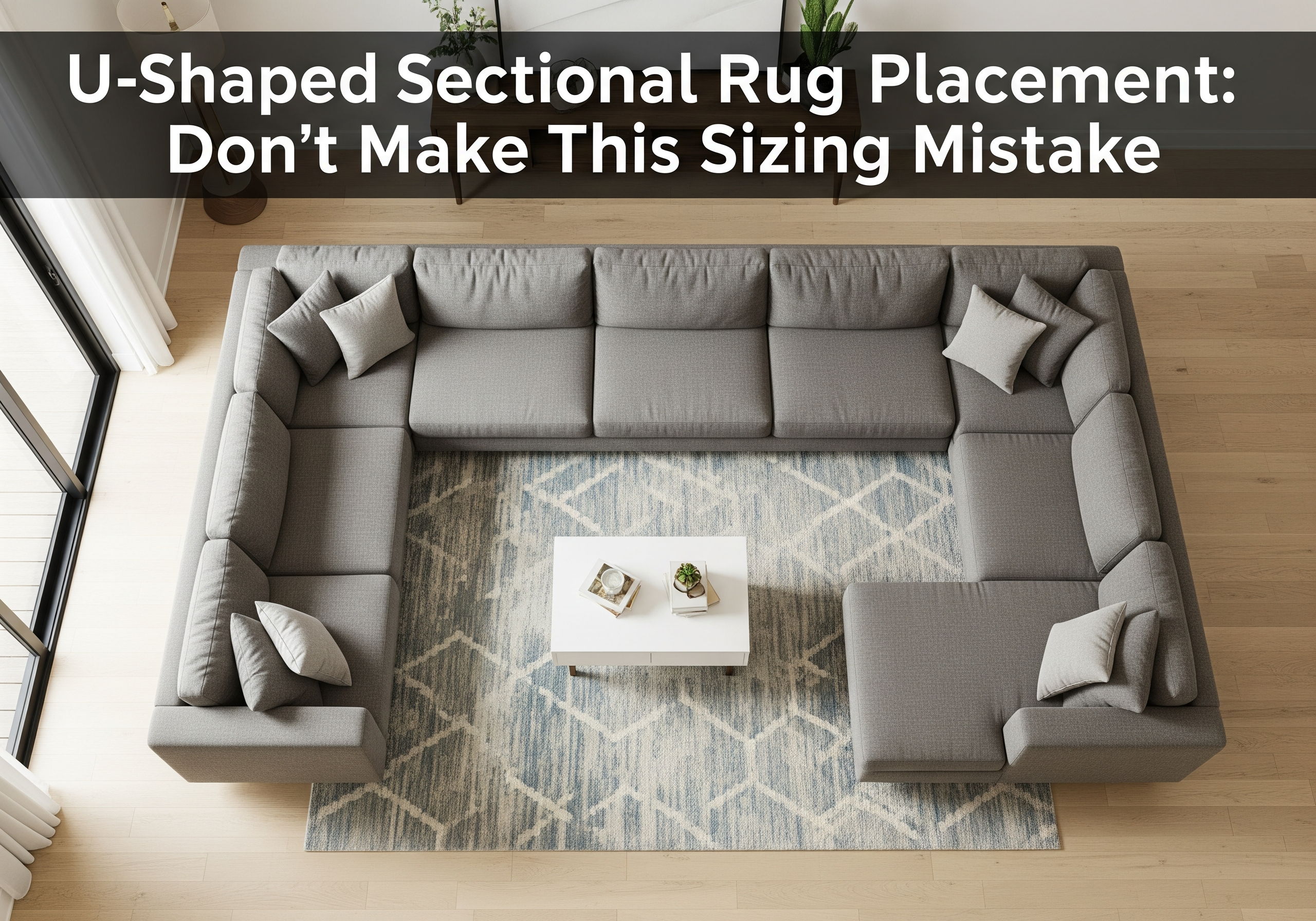
Getting a rug under your U-shaped sectional wrong costs you money and makes your living room feel off. I’ve seen countless homes where an expensive sectional sits on a rug that’s either swimming in extra space or cramped like sardines in a can.
The sizing mistake most people make? They buy an 8×10 rug for their U-shaped sectional because “that’s a standard living room size.” Wrong. A U-shaped sectional needs more strategic thinking than that.
The Most Common U-Shaped Sectional Rug Mistake
Here’s what happens in 7 out of 10 living rooms: Someone buys a gorgeous U-shaped sectional, then grabs the first large rug they see. The rug either stops awkwardly at the front legs, leaving the back section floating on bare floor, or it’s so small it looks like a bath mat under a king-sized bed.
The real mistake isn’t just size; it’s not understanding how U-shaped sectionals interact with floor space differently than regular sofas.
A U-shaped sectional has three seating sides. Each side needs proper rug coverage, or your room looks disjointed. When one section sits on the rug while another doesn’t, your eye notices the imbalance immediately.
How to Size Your Rug Correctly؟
Measure your U-shaped sectional first. Get the total width from one end to the other, and the depth from the back to the front edge. Add these numbers to a piece of paper.
Most U-shaped sectionals range from 120 to 150 inches wide and 100 to 120 inches deep. That’s 10-12 feet wide and 8-10 feet deep in real terms.
Now for the rug math that actually works:
- Small U-shaped sectional (under 120″ wide): 9×12 or 10×13 rug minimum.
- Medium U-shaped sectional (120-140″ wide): 10×14 or 11×15 rug.
- Large U-shaped sectional (over 140″ wide): 12×15 or larger custom size.
The rug should extend 18-24 inches beyond the sectional’s front edge. This gives you walking space and prevents the “postage stamp” effect where furniture overwhelms the rug.
The Three Placement Rules That Work Every Time
Rule 1: All front legs on, or all legs off. Pick one approach and commit. Mixing it—some legs on, some off—creates visual chaos.
The “all front legs on” method works best for U-shaped sectionals. It anchors the seating area, defines the conversation zone, and makes the room feel intentional. The back legs can hang off without issues.
The “all legs off” approach only works if your rug is large enough to extend well beyond the sectional on all sides. We’re talking 30+ inches of rug showing past the furniture. Most people don’t have rooms big enough for this.
Rule 2: Center the rug under the sectional’s center point. Find the middle of your U-shape (usually where the TV or focal point sits directly across), and center your rug on that line. Don’t center it on the room—center it on the furniture arrangement.
Rule 3: Leave 18-24 inches of rug visible in front. This buffer zone matters more than you think. It’s where feet land when people sit down, where coffee tables sit, and where the eye expects to see floor covering. Skimp here, and everything looks cramped.
Room Size Impacts Rug Choice
Your room dimensions change everything about rug selection.
Small living rooms (under 200 square feet): A U-shaped sectional already dominates the space. Your rug needs to acknowledge this without making the room feel smaller. Go for a rug that extends 12-18 inches beyond the front edge. The sides can be tighter—just 6-8 inches of clearance works.
Medium living rooms (200-350 square feet): You’ve got breathing room. Aim for that 18-24 inch extension on all visible sides. The rug should anchor the seating area without touching the walls. Leave at least 12 inches of bare floor between the rug edge and walls.
Large living rooms (over 350 square feet): Size up aggressively. A rug that looks huge in the store often looks reasonable in a large room. Consider a 12×18 or even 14×18 rug. The extra size prevents your U-shaped sectional from looking like an island in an ocean of flooring.
The Coffee Table Factor
Your coffee table sits in the middle of that U-shape, and it needs rug coverage too.
The entire coffee table should sit on the rug—all four legs, no exceptions. If your coffee table hangs off the rug edge, it creates a tripping hazard and looks unfinished.
Measure from the back of your sectional to the far edge of the coffee table. Add 12-18 inches. That’s your minimum rug depth. This ensures the table stays anchored and your setup looks cohesive.
Round coffee tables are more forgiving than rectangular ones, but the same rule applies—all legs on the rug.
What Works Better: Rectangular or Square Rugs?
Rectangular rugs work for most U-shaped sectionals. The proportions match the elongated footprint of the seating arrangement. A 10×14 or 9×12 rectangle fits naturally under the U-shape and extends properly in front.
Square rugs can work for compact U-shaped sectionals in square rooms. A 10×10 or 12×12 square rug centers well under a smaller U-shape and creates a cozy, defined zone. But most living rooms are rectangular, making rectangular rugs the safer choice.
Avoid round rugs under U-shaped sectionals. The curved edge fights against the sectional’s linear arms and straight edges. Round rugs work for circular conversation areas—not for structured seating like a U-shape.
Budget-Friendly Sizing Solutions
Can’t afford that massive 12×15 rug? Here are workarounds that don’t compromise style:
Layer two rugs. Put a larger, affordable natural fiber rug (jute or sisal) as a base layer. Add a smaller, nicer rug on top in front of the sectional. This creates dimension and lets you spend money where eyes land first—the high-traffic area.
Use rug pads strategically. A good rug pad adds thickness and makes a slightly smaller rug feel more substantial. It won’t fix a rug that’s genuinely too small, but it helps a borderline-sized rug perform better.
Go with quality in a smaller size rather than cheap in a larger size. A well-made 9×12 rug beats a flimsy 10×14 rug every time. The smaller quality rug will look intentional; the larger cheap rug will look like a mistake.
Mistakes That Make Rooms Look Smaller
Mistake: Choosing a rug that barely reaches the front legs. This chops your room in half visually. The sectional looks like it’s teetering on the edge of a cliff.
Mistake: Matching rug color too closely to the floor. Your rug should define the seating area, not disappear into the flooring. Create contrast—light rugs on dark floors, darker rugs on light floors.
Mistake: Ignoring the sectional’s orientation. If your U-shaped sectional opens toward the TV wall, your rug shape needs to extend in that direction. Don’t buy a symmetrical rug size if your furniture placement isn’t symmetrical.
Mistake: Pushing the sectional against the walls. U-shaped sectionals work best floating in the room with space behind them. When you shove them against walls, you limit rug placement options and make the room feel cramped.
Testing Before You Buy
Most people order online and hope for the best. That’s gambling with several hundred dollars.
Use painter’s tape to mark your rug dimensions on the floor before purchasing. Live with the tape outline for a few days. Walk around it. Sit on your sectional and look at it. Does the size feel right? Too big? Too small?
This tape trick saves returns, shipping fees, and buyer’s remorse. Ten dollars of painter’s tape beats a $500 mistake.
The Takeaway
Your U-shaped sectional needs a rug that’s bigger than you think. Add 18-24 inches to the front edge, make sure all front legs sit on the rug, and choose a size that matches your sectional’s footprint—not just your room’s size.
Stop defaulting to 8×10 rugs. Stop hoping a small rug will “work fine.” Stop ignoring the coffee table in your measurements.
Measure your sectional, add the buffer zones, and buy the right size the first time. Your living room will look pulled together, and you’ll stop wondering why the space feels off.
