

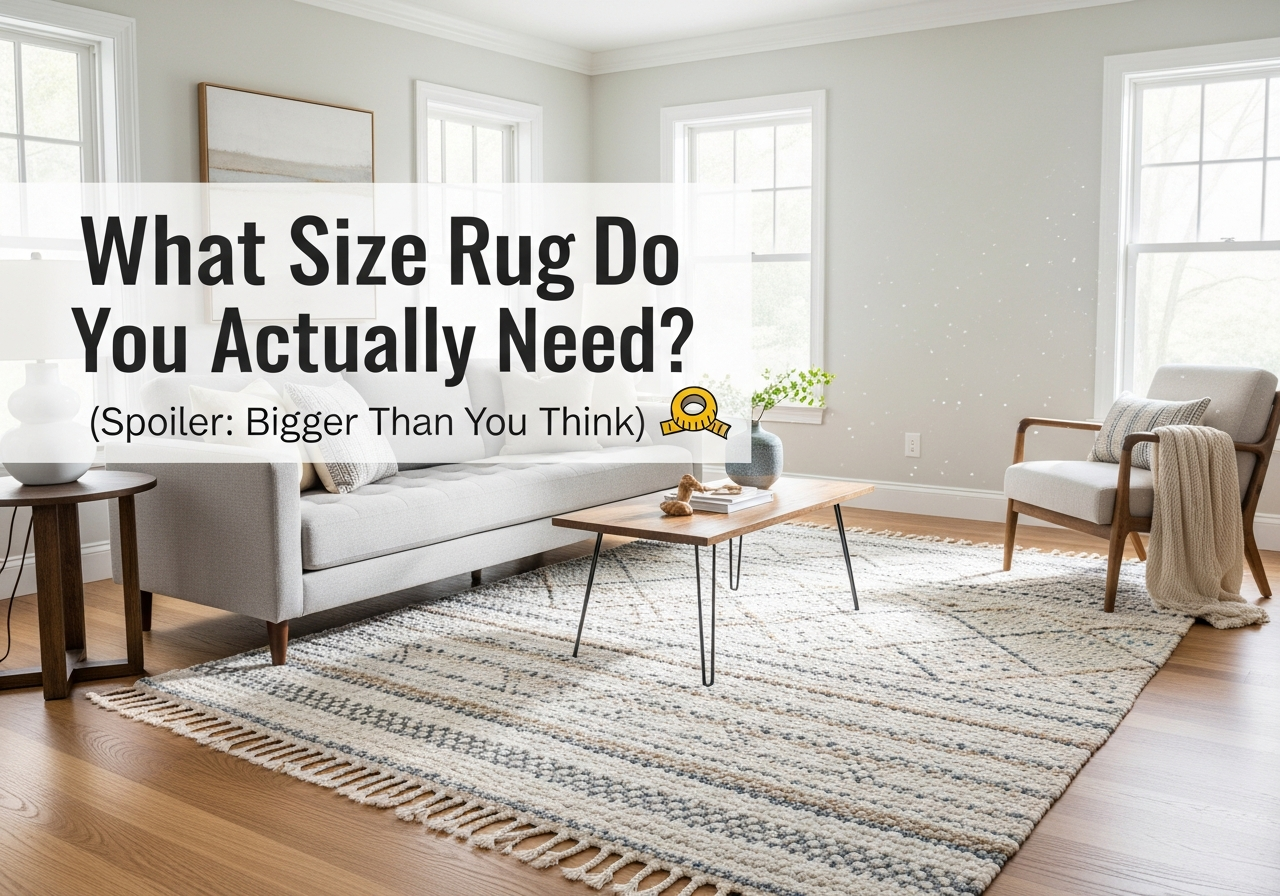
You’ve probably stood in your living room, tape measure in hand, convinced that a 5×7 rug will work perfectly. Then it arrives, you roll it out, and suddenly your beautiful sofa looks like it’s perched on a postage stamp.
Why Rug Size Matters More Than You Think?
A rug isn’t just about covering your floor. It’s the foundation that ties your entire room together. When you choose the wrong size, everything feels off balance.
Too small, and your furniture floats awkwardly in space. Your room looks choppy and disjointed. Too large (which is rare), and you’ve wasted money on a rug you can’t even see.
The right size creates harmony. It defines zones, anchors furniture, and makes your space feel intentional and complete.
The Golden Rule for Living Room Rugs
Here’s what actually works: all your furniture should sit on the rug, or at least the front legs of every piece.
That means your sofa, chairs, coffee table, and side tables need to make contact with the rug. This creates a cohesive conversation area that feels grounded and pulled together.
The minimum approach puts just the front legs of your furniture on the rug. This works in smaller spaces, but you’ll need at least 8×10 to pull it off in most living rooms.
The better approach gets all furniture legs on the rug. This requires a 9×12 or larger, but the result looks infinitely more polished and expensive.
Living Room Size Guide
Small living rooms (10×12 feet or less) need a 5×7 or 6×9 rug at a minimum. If you can squeeze in an 8×10, do it. The extra coverage makes a dramatic difference.
Medium living rooms (12×18 feet) demand an 8×10 or 9×12. The 8×10 works if you’re doing the front-legs-only approach. Go with 9×12 for full furniture coverage.
Large living rooms (18×20 feet or more) start at 9×12 and often need 10×14 or even 12×15. Yes, these rugs exist. Yes, they’re worth it.
Bedroom Rugs: The Comfort Factor
Your bedroom rug serves a specific purpose: giving your feet something soft to land on when you roll out of bed.
For a queen bed, you want at least an 8×10 rug. Position it so the rug extends 18-24 inches beyond each side of the bed and at least 2-3 feet beyond the foot of the bed.
King beds need a 9×12 minimum. Some people even go up to 10×14 to get that luxurious hotel feel where the rug extends well into the room.
The alternative layout puts a runner on each side of the bed. Use runners that are at least 2.5×8 feet. This works great in narrow bedrooms where a large rug would crowd the space.
Dining Room Rules Are Non-Negotiable
This is where people mess up most often. Your rug needs to extend at least 24 inches beyond your table on all sides.
Why? Because when someone pulls out a chair to sit down, that chair needs to stay on the rug. Nothing ruins dinner like chair legs catching on the rug edge every time someone adjusts their seat.
For a 6-person table (roughly 36×60 inches), you need at least an 8×10 rug. An 8×11 works better if your table is on the longer side.
For an 8-person table (roughly 40×80 inches), go with a 9×12 minimum. A 10×14 gives you comfortable breathing room.
Round tables follow the same 24-inch rule. A 48-inch round table needs at least a 6-foot round rug. A 60-inch table requires an 8-foot round rug.
Kitchen and Entryway Sizing
Kitchen runners should extend at least 2 feet beyond your counter or island on each end. A standard kitchen needs a 2.5×8 or 3×10 runner, not the wimpy 2×6 that most people buy.
In front of the sink, use a 2×3 or 2.5×4 mat. Anything smaller looks like an afterthought.
Entryways need rugs that extend at least 12 inches beyond your door swing on each side. For a standard 36-inch door, that means a minimum 5×7 rug. A 6×9 looks better and gives you actual room to wipe your feet.
Home Office Essentials
Your desk chair needs to roll freely on the rug, even when you push back from the desk. Measure your chair’s full range of motion and add 12 inches on all sides.
Most home offices need at least a 5×7 under the desk. If you have a larger L-shaped desk or want the whole office defined, go with an 8×10.
The Layering Exception
Layering a smaller rug over a larger natural fiber rug breaks some of these rules intentionally. Your base rug (usually jute or sisal) should follow the standard sizing guidelines. Then you can add a smaller, decorative rug on top.
This works great in living rooms and bedrooms where you want texture without the full cost of a large decorative rug.
Common Sizing Mistakes to Avoid
Buying a 5×7 for a standard living room is the most frequent error. These rugs work in very small apartments or as accent pieces, not as main living room rugs.
Choosing round rugs for rectangular furniture arrangements rarely works. Round rugs need round or curved furniture to look intentional.
Ignoring furniture placement when measuring leads to rugs that technically fit the room dimensions but don’t actually work with how you’ve arranged your furniture.
Going too small to save money backfires. A too-small rug makes your entire space look cheap, even if your furniture costs a fortune.
How to Measure Your Space Correctly?
Clear your furniture to the edges of where you want your rug zone to end. Use painter’s tape on the floor to mark out the rug size you’re considering.
Live with the tape for a few days. Walk around it, move furniture into position, and see how it actually feels. This simple step prevents expensive mistakes.
Take photos from different angles. Sometimes what feels right in person looks off in pictures, and vice versa.
Measure twice, order once. And remember: when you’re between sizes, always size up.
Budget-Friendly Ways to Go Bigger
Large rugs cost serious money, but you have options. Natural fiber rugs like jute, sisal, and seagrass come in huge sizes for reasonable prices. A 9×12 jute rug often costs less than a 5×7 wool Persian.
Rug pads not only protect your floors and prevent slipping—they also make rugs feel more substantial and luxurious. A good pad can make a budget rug perform like something twice its price.
Off-season sales happen. January, July, and post-holiday periods offer the best discounts on rugs. Sign up for emails from major rug retailers and wait for the right sale.
When Bigger Isn’t Better?
Very small rooms (under 10×10 feet) sometimes work better with no rug at all or with a small accent rug that doesn’t try to anchor furniture. Forcing a furniture-anchoring rug into a tiny space can make it feel cramped.
High-traffic hallways often do better with runners sized to leave 4-6 inches of floor visible on each side rather than wall-to-wall coverage.
Rooms with beautiful hardwood or tile that you want to showcase might need an accent rug rather than full coverage.
The Real Answer to “What Size”
Start with this cheat sheet:
- Living room with sectional: 9×12 minimum, 10×14 better.
- Living room with sofa and chairs: 8×10 minimum, 9×12 better.
- Queen bedroom: 8×10.
- King bedroom: 9×12.
- 6-person dining: 8×10.
- 8-person dining: 9×12.
- Home office: 5×7 minimum, 8×10 for larger desks.
- Entryway: 5×7 minimum, 6×9 better.
When in doubt, measure your furniture layout and add 18-24 inches on all sides. That’s your rug size.
And yes, it’s bigger than you think. But it’s also the difference between a room that looks professionally designed and one that looks like you tried to save money in the wrong place.
