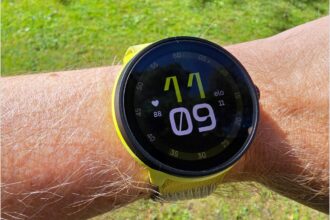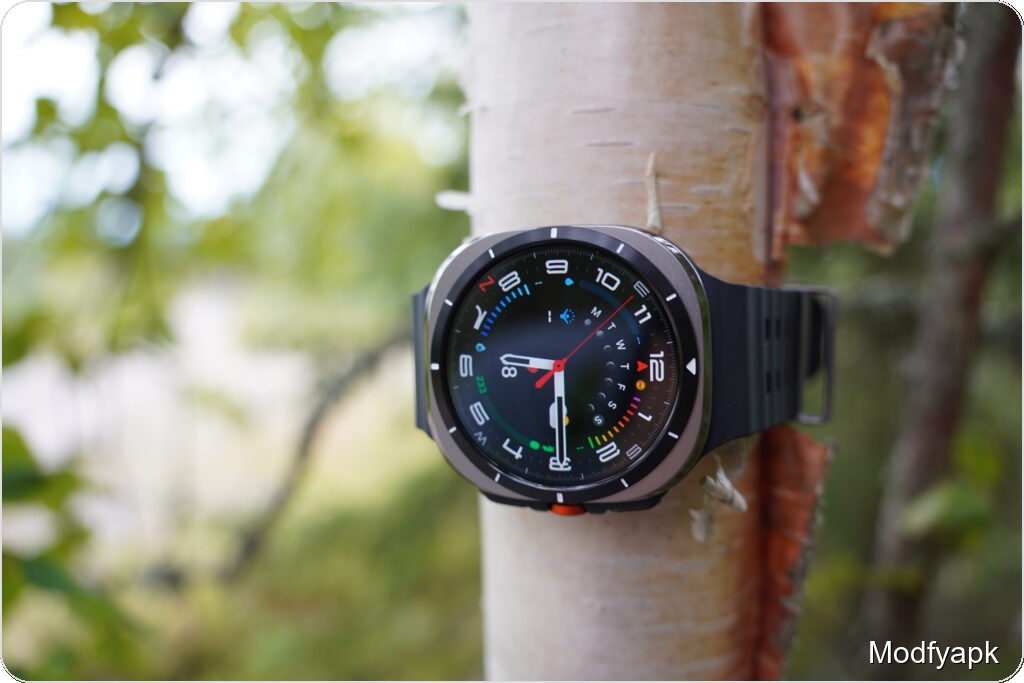
Samsung’s newest top-of-the-line smartwatch is the Galaxy Watch Ultra. It’s a big, tough Wear OS watch that’s meant to be used on adventures, but it’s not very different from the Galaxy Watch 7 underneath, even though it costs a lot more.
The Ultra only comes in one big size, 47mm. The titanium case alone weighs 60.5 grams, which is a lot more than the base Watch 7’s 42.3 grams. The Suunto Ocean, which is in the same size range, weighs 99 grams with the strap attached. Adding Samsung’s Marine strap adds 31.5 grams, making the whole thing about 92 grams on the wrist.
Specifications
| Price | 699 € |
| Dimensions | 47,4 x 47,4 x 12,1 mm |
| Display | 1.5″ AMOLED (480 x 480 pixels, 327 PPI) |
| Battery | 590 mAh |
| Chipset | Exynos W1000 (5-core, 3 nm) |
| Connectivity | GPS, NFC, Bluetooth 5.3, Wi‑Fi 2.4 GHz & 5 GHz |
| OS compatibility | Android 11.0 or newer |
| Sensors | Heart rate, ECG, blood pressure, BIA, continuous SpO2, skin temperature |
| Water and impact resistance | 10 ATM, IP68, MIL-STD-810G |
Price and competition
Six hundred euros gets you the Galaxy Watch Ultra, which is pricey and only comes in an LTE version. On the other hand, the least expensive Galaxy Watch 7 comes in a 40mm case and costs around 319 euros. The Apple Watch Ultra 2 (from 799 euros), the Suunto Ocean (799 euros), and the Garmin Enduro 2 (813 euros) are Ultra’s main competitors in the high-end sport and smartwatch market.
Design and display
The shape of the watch, a rounded square, makes me think of Apple’s rival right away. Although the case is square, the screen is round, so the extra screen space for the 1.5-inch face isn’t fully realized.
The Super AMOLED screen has 480 by 480 pixels (327 ppi) and is covered by sapphire glass that doesn’t scratch. The display quality is great, showing true colors and fine details, and it has a mode called “Always On Display.”
The screen can be read in bright sunlight thanks to its peak brightness of 3,000 nits. There is also a mode just for nights that can change the colors of the screen to red ones that are easier on the eyes for use at night.
The official measurements are 47.4 x 47.4 x 12.1 mm, but Samsung doesn’t count the optical heart-rate module when measuring the thickness. The real thickness is more like 16 mm.
Fit and controls
Both on the wrist and in the eye, the Ultra looks huge. That fits with its adventure-themed name, but smaller wrists will find it too big. The reviewer has a pretty thin wrist, so the watch looked almost comically big on them. However, the fit and comfort were fine. The Ultra is not a good choice for people with even smaller wrists because it can move around and be uncomfortable.
There is a responsive touchscreen, an action button that can do more than one thing, and two more physical buttons on the right side. The way buttons work is straightforward and can be changed. The top button takes you back to the home screen by default, and a double-press takes you to the previous app. A long press calls Bixby, and an even longer press makes an emergency call. The lower button takes you back to the previous screen, and the main button does different things depending on the app. It’s easy to use buttons with gloves on because they feel good to the touch. The crown on the watch does not turn.
Samsung has a new way of fixing straps, so Ultra straps won’t work with older Galaxy Watch models. Extra straps can be bought separately for a few dozen euros and come with the watch. There are different types of straps, such as Marine for use in the water, Trail that looks like fabric for use on trails, and a hybrid PeakForm choice.
Hardware and durability
In terms of how it works, the Ultra is mostly the same as the smaller Galaxy Watch 7. The sensors, health functions, and dual-frequency GPS are all the same on both. The Ultra’s batteries last longer, it’s built stronger, and it looks good.
The case is made of titanium instead of aluminum, and it has a 10 ATM rating, which means it can withstand water up to 100 meters deep. The Watch 7 only has a 5 ATM rating. But there is some fine print that says you can’t use the watch in deep water. It can only handle ten minutes of deep water and isn’t made to handle high-pressure water jets like those used in paddle sports. So, the difference between the two types in how well they resist water is mostly theoretical. Both watches can be used for swimming and light fishing, but the Samsung Ultra isn’t made for scuba diving or some water sports where the Apple Watch Ultra 2 or Suunto Ocean would be better.
There is also a MIL-STD-810G grade on the Ultra, which is useful if you often knock your watch around while working out. Still, for the price of the Ultra, you could almost get two Watch 7s instead.
Battery and charging
The Ultra has a 590 mAh battery that can last up to 100 hours in power-saving mode and about 60 hours of normal use on a single charge. Watch 7, on the other hand, is said to last about 30 hours. When compared to Suunto and Garmin’s focused sports watches, Ultra’s battery life is still pretty short. Many sports watches can go for weeks without being charged.
In real life, the writer had to charge the Ultra about every other night or during the day, which is in line with Samsung’s claims about how long it will last.
You need the dock that comes with it to charge it now; Qi wireless charging and reverse wireless charging are no longer allowed. Samsung made this change to make room for a new optical sensor that gives better heart-rate readings from the wrist.
Heart rate and sensors
The Ultra’s optical heart-rate sensor is still not as fast as a chest strap’s during interval training, and it didn’t always pick up on rapid spikes and dips as quickly as the strap did. The Ultra, on the other hand, did much better than many other wrist-based sensors. During steady-state runs, it gave numbers that were very close to those of a chest strap. The watch does not work with a chest strap heart monitor.
Dual-frequency GPS locks on quickly and gives you correct information about where you are. Sleep tracking is built in, and the reviewer’s tests showed reliable results.
Sports features and data
Ultra has new multisport support that lets you combine more than one activity into a single session. For instance, you can record a triathlon without having to start and stop each section by hand. Custom multisport profiles can be made, but only a few sports can be chosen from. For example, walking cannot be added as an activity. A separate power meter is needed for the FTP test that cyclists take to figure out their highest sustainable power.
Samsung and the app that goes with it give you standard exercise measures like pace and effort, but you could get a lot more out of recovery insights. The good things about the watch and app are that they can measure body fat and makeup, which is something that not many other devices can do. Ultra also gives an AGE measure that is supposed to figure out biological age, but it is not clear what the result means, so the user is not sure if it is good or bad. The system’s health statistics are based on BMI, and it doesn’t take into account people who are too short or too tall.
Compatibility and software
Any Android phone or tablet running Android 11 or later can connect to the Galaxy Watch Ultra. However, some health tools are only available on Samsung phones and require Samsung Health. For this review, the watch was paired with a OnePlus Nord 4, so there were no health tools for Samsung phones. Some of these features are warnings for irregular heartbeats, a tool for finding sleep apnea, an ECG, Galaxy AI-powered features, suggested replies, and a double-tap gesture.
The watch has a chipset called Exynos W1000 that was made using a 3nm method. This is the same silicon that was used in models that cost less. It has Wear OS 5 and One UI 6 on top of it. It’s easy to learn how to use, fast, and it works with a lot of apps, including Spotify.
The watch needs more than one Samsung app to be set up and do some things. You need Samsung Health and Samsung Wearables to change the face of your watch. Samsung Health Monitor is a third app that can be used on Samsung phones. It would be easier to use if these were all in one app.
Workout data is synced to Samsung Health, but the watch also has third-party apps like Strava that you can use. Samsung Health has challenges, guided workout videos, and a food diary to keep track of calories.
Pros and cons
Good
- Wear OS and broad app support
- Premium look and build quality
- Extremely bright, high-quality display
- Improved wrist-based heart-rate accuracy
Bad
- High price
- Massive size with no smaller options
- Some features work only with Samsung phones
- Requires multiple companion apps
- Not rated for varied high-pressure water sports
Verdict
The Galaxy Watch Ultra is probably the best Wear OS smartwatch on the market right now. Its price-to-value ratio is still not clear. It has a lot of the same hardware and software as the Galaxy Watch 7. The writer didn’t think that the Ultra’s longer battery life and greater durability made it worth the extra 699 euros. It’s not possible that the regular Galaxy Watch will break down quickly or lack important features.
The Ultra is a pretty standard smartwatch, even though it’s marketed as an activity watch. People who want a specific device for endurance or expedition should look at Suunto or Garmin. Even though those watches don’t have as many features as the Ultra, they definitely beat it when it comes to battery life and being able to handle demanding water sports. They also give serious athletes more information about sports and healing.