

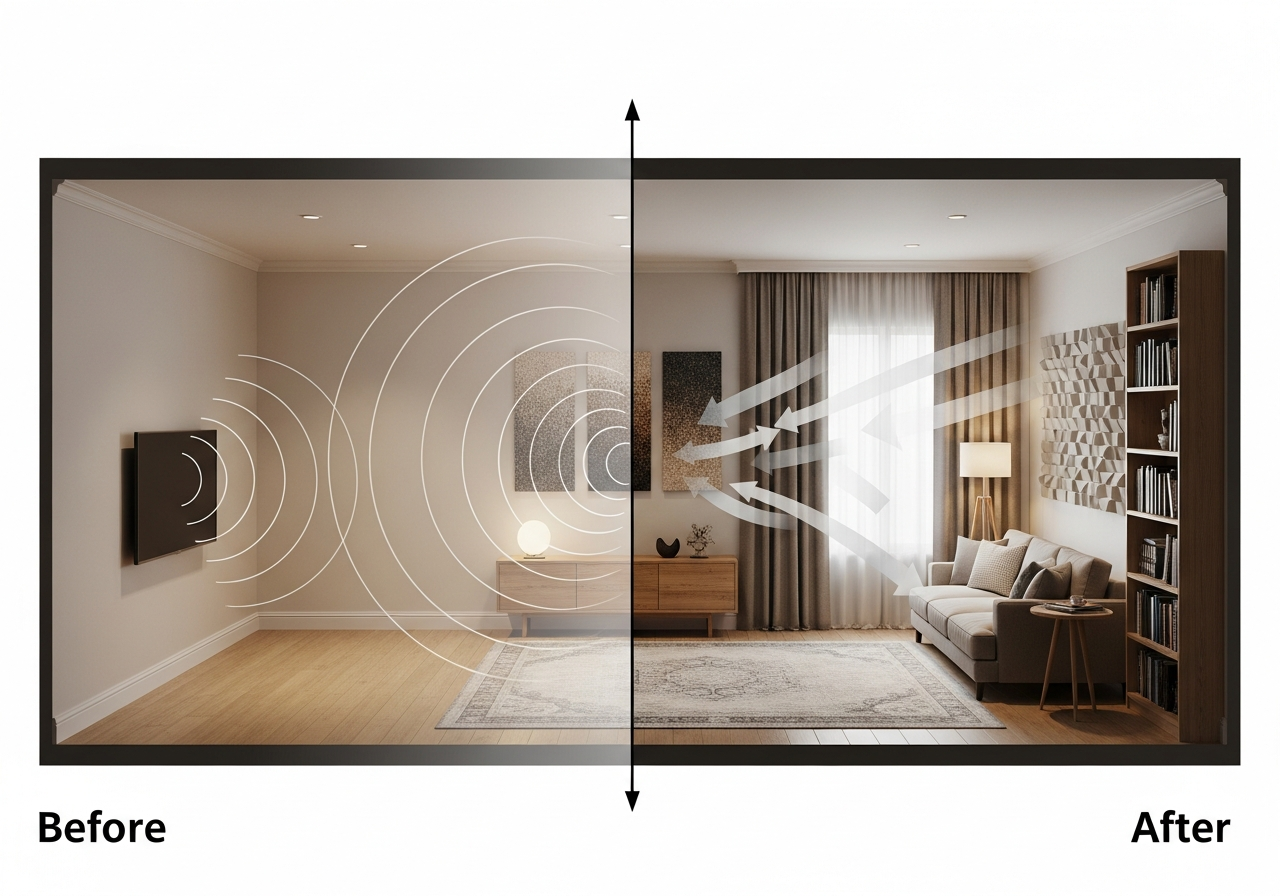
Walking into your living room shouldn’t feel like stepping onto a basketball court. That hollow, reverberating sound when you speak or when footsteps hit the floor signals one thing: your space has an echo problem.
The good news? You can fix it without hiring an acoustics expert or spending thousands of dollars.
Why Your Living Room Echoes?
Sound waves bounce off hard surfaces. When they have nothing to absorb them, they keep bouncing around the room, creating that gymnasium effect you’re hearing.
Modern home design trends have made this worse. Open floor plans, hardwood floors, large windows, high ceilings, and minimalist furniture arrangements all contribute to poor acoustics. Remove the carpet, strip away heavy curtains, and add sleek leather furniture, and you’ve created the perfect recipe for echo.
The technical term is reverberation. It happens when sound reflects off multiple surfaces before finally dying out. In a gym, that’s expected. In your living room, it’s annoying and makes conversation difficult.
Start With the Floor
Your floor is the largest flat surface in the room and one of the main culprits behind echo problems.
Area rugs are your first line of defense. A thick area rug in the main seating area absorbs sound waves before they can bounce back up. Look for rugs with dense pile or those made from wool—the thicker and heavier, the better the sound absorption.
Size matters here. That tiny 3×5 rug under your coffee table isn’t doing much. You want something substantial that covers a good portion of your floor space. Aim for a rug that extends at least 12 inches beyond your furniture on all sides.
Rug pads serve double duty. They prevent slipping and add another layer of sound absorption. Get the thickest pad you can find.
For rooms with wall-to-wall hard flooring, consider multiple rugs. One in the seating area, another under the dining table if your living room connects to the dining space. Every bit of soft surface helps.
Address Your Walls
Bare walls reflect sound like mirrors reflect light. Breaking up those smooth surfaces dramatically reduces echo.
Hang fabric-backed artwork and wall hangings. Canvas prints absorb more sound than framed glass pictures. Tapestries, woven wall hangings, and fabric art pieces work even better. The fabric traps sound waves instead of bouncing them back into the room.
Acoustic panels don’t have to look industrial. Modern acoustic panels come in decorative designs, colors, and patterns. You can find ones that look like regular wall art. Mount them on the walls that create the most echo, typically the ones parallel to each other.
Add floating shelves with books and decorative items. A full bookshelf is an excellent sound absorber. The irregular surfaces of book spines, the paper inside, and the varied depths all help scatter and absorb sound waves. If you don’t have built-in shelving, install floating shelves and fill them up.
Consider fabric wall panels. These stretched fabric frames add texture and color while absorbing sound. You can even DIY them using wooden frames and your choice of fabric.
Window Treatments Make a Difference
Windows are another hard, reflective surface. Large windows mean large echo contributors.
Replace thin blinds with heavy curtains. Thick, floor-length curtains made from dense fabric absorb significant amounts of sound. Velvet, suede, or heavy cotton works best. Make sure they’re wide enough to cover the entire window when closed, with some fabric bunching at the sides when open.
Layer your window treatments. Use both curtains and blinds. The multiple layers create air pockets that trap sound. Even when you have the curtains open during the day, the bunched fabric at the sides still provides some acoustic benefit.
Cellular shades are another option. Their honeycomb structure creates tiny air pockets that help dampen sound. They’re less effective than heavy curtains but better than nothing.
Rethink Your Furniture
Hard furniture on hard floors creates an echo chamber—your furniture choices directly impact room acoustics.
Upholstered furniture absorbs sound. That sleek leather sofa might look great, but fabric upholstery performs better acoustically. If you’re not ready to replace furniture, add throw pillows, blankets, and cushions. Every soft surface helps.
Choose furniture with irregular surfaces rather than smooth, flat ones. A tufted sofa back absorbs more sound than a smooth leather one. Wicker and rattan furniture pieces scatter sound waves because of their textured surfaces.
Position larger furniture pieces away from walls. A sofa pulled slightly away from the wall creates space for sound to dissipate. It also prevents the wall from amplifying the reflection of sound bouncing off the sofa.
Ottoman, poufs, and upholstered benches add seating and sound absorption. They’re functional and help with acoustics.
Don’t Forget the Ceiling
High ceilings look impressive, but create acoustic nightmares. Sound bounces up, hits the ceiling, and comes back down amplified.
Acoustic ceiling tiles offer a permanent solution. Modern versions don’t look like office ceiling tiles. You can find attractive options that complement home decor while providing excellent sound absorption.
For a less permanent fix, hang fabric from the ceiling. Decorative fabric draping or suspended fabric panels break up the smooth ceiling surface. This works especially well in rooms with very high ceilings.
Cloud panels are acoustic panels designed to hang from the ceiling. They come in various shapes and colors and can become a design feature rather than an eyesore.
If you have a ceiling fan, that’s actually helpful. The fan blades and motor housing create surface irregularities that scatter sound waves.
Strategic Decor Choices
Every item in your room either helps or hurts the acoustic environment.
Plants are natural sound absorbers. Larger plants with broad leaves work best. Position them in corners where sound tends to collect. The leaves absorb high-frequency sounds, while the pots and soil help with lower frequencies. A few strategically placed large plants make a noticeable difference.
Floor lamps with fabric shades add vertical soft surfaces. They’re functional lighting that doubles as sound absorption. Choose lamps with drum shades or larger fabric shades for maximum effect.
Throw blankets draped over furniture arms or backs add texture and sound absorption. Keep a few decorative blankets in baskets around the room. They’re practical and improve acoustics.
Decorative room dividers or folding screens break up large open spaces. They create barriers that prevent sound from bouncing across the entire room. Choose ones upholstered in fabric for maximum benefit.
Fix Problem Areas
Some rooms have specific acoustic trouble spots that need targeted solutions.
Corners collect sound. Place tall plants, floor lamps, or corner shelving units in empty corners. These break up the 90-degree angle that reflects sound so efficiently.
Parallel walls create a flutter echo. That’s the rapid repetition you hear when sound bounces back and forth between two flat surfaces. Break this up by treating one wall differently from the other. Add a bookshelf to one wall and artwork to the opposite wall.
Large empty walls need the most attention. A gallery wall with multiple frames of different sizes creates surface variation. Mix in some three-dimensional pieces like wall sculptures or decorative plates.
Test Your Changes
Make changes gradually and test the results. Clap your hands sharply in the center of the room. Listen for the echo. As you add sound-absorbing elements, that echo should shorten and soften.
Have a conversation at normal volume. If you’re straining to hear or if your voice sounds hollow, you need more absorption. Good room acoustics mean clear conversation without raising your voice or dealing with muddiness from too much reverb.
Music provides another test. Play something with clear vocals and distinct instruments. In a room with too much echo, the sound becomes muddy and unclear. As you improve the acoustics, individual instruments become more distinct, and vocals sound clearer.
Budget-Friendly Solutions
You don’t need to spend a fortune to fix echo problems.
Thrift stores often have heavy curtains, rugs, and upholstered furniture at a fraction of retail prices. The acoustic properties don’t care if something is secondhand.
DIY acoustic panels cost much less than store-bought versions. You need rigid insulation board, fabric, and a frame. Tutorials online walk you through the simple construction process.
Moving blankets work as a temporary acoustic treatment. They’re designed to be thick and sound-dampening. Hang them on walls as a temporary fix while you figure out permanent solutions.
Rearranging existing furniture costs nothing. Pull pieces away from walls, angle furniture to break up parallel surfaces, and position upholstered pieces strategically.
Common Mistakes to Avoid
Don’t rely on thin materials. That lightweight cotton curtain or thin area rug won’t make much difference. You need mass and thickness for effective sound absorption.
Avoid treating just one area. Fixing the floor but ignoring the walls and ceiling won’t solve the problem. Sound bounces in all directions. Address multiple surfaces for best results.
Don’t go overboard. A room can become too dead acoustically. You want to reduce echo, not eliminate all sound reflection. Some reflection gives music and voices warmth and a natural sound.
The Bottom Line
Stopping your living room from echoing comes down to adding soft, irregular surfaces that absorb and scatter sound waves. Rugs, curtains, upholstered furniture, wall treatments, and strategic decor choices all contribute to better room acoustics.
Start with the biggest changes first. A large area rug and heavy curtains provide immediate improvement. Then layer in smaller additions until the echo disappears and your living room sounds as good as it looks.
