Overview
JBL’s over-ear Tour One M3 sits at the top of the company’s closed-back headphone lineup and leans hard into versatility. Launched at the start of the year and arriving in stores in April, the Tour One M3 pairs strong active noise cancellation with a unique Smart Tx transmitter and surprisingly broad connectivity, including lossless wired playback.
What you get
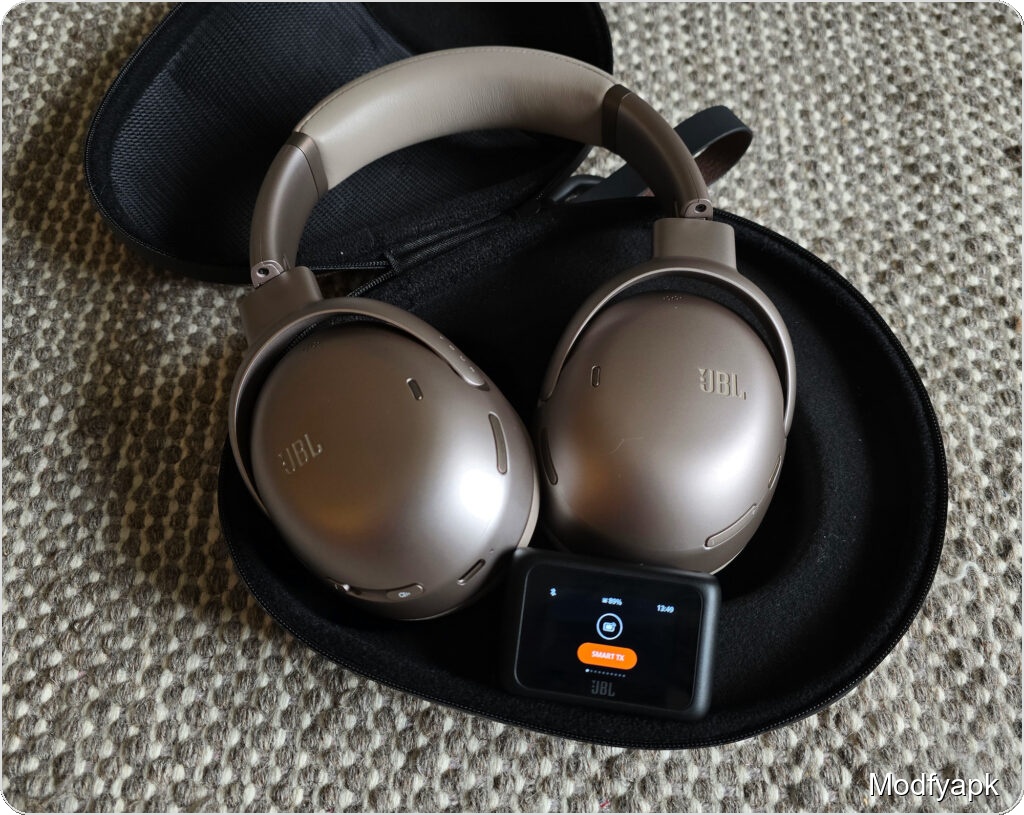
The headphones ship with a USB-C charging cable, a 3.5 mm to USB-C headphone cable, and a USB-A to USB-C adapter. The Smart Tx-equipped bundle adds the transmitter itself and a sturdy carrying case with a pocket sized to hold the transmitter and cables.
Design and comfort
The Tour One M3 is a slightly divisive design. Immediately noticeable positives include a light feel—278 grams—which is modest for the class, and generously padded ear cups and headband that make multi-hour sessions comfortable. The ear pads are roomy enough that glasses temples do not get pinched.
The padding uses a faux-leather surface that warms up fairly quickly, so long listening sessions may invite brief breaks. Finish is silk‑matte on our review unit, giving a more subdued look than JBL’s usual bold styling, though there is still some visible plastic on the cups that feels a bit out of place at this price. Build is solid and free from creaks, but the materials are sensitive enough that JBL declined to apply an IP rating. The headphones handled a slushy spring commute without issue, but they are not intended for heavy sweat or sport use.
Physical controls are traditional buttons placed on the edges of both ear cups. The right cup houses the USB-C charging port, an ANC control, and a combined power/Bluetooth switch. The left cup holds the volume buttons. Buttons are reasonably sized but sit fairly shallow, so finding volume and voice assistant controls takes a moment; the power button is easy to locate. Touch controls live on the right cup’s surface for play/pause, skip, and voice assistant functions.
Smart Tx transmitter and connectivity
The Tour One M3’s headline feature is the Smart Tx transmitter, which lets the headphones work wirelessly with older or non-Bluetooth sources. The transmitter doubles as a remote for many functions. The headphones support Bluetooth 5.3 with SBC, AAC, LDAC, and LC3 codecs, and they also support Auracast for broadcasting to multiple compatible receivers at once—particularly useful when paired with the Smart Tx.
Internally the headphones include a DAC and support lossless USB-C and analog playback, making them unusually flexible for wired use. Pairing is handled via the power button’s dedicated position. You can control most functions with the transmitter, the physical buttons, touch controls, or via the JBL Headphones mobile app on Android and iOS.
Companion app and customization
The JBL Headphones app unlocks the full feature set: ANC modes and tuning, a multi-band equalizer with presets, remappable controls, and more. Tour One M3 also supports Personi‑Fi 3.0 for hearing-based EQ adjustment. The app-driven customization is deep and worth exploring to get an optimal sound signature.
Comfort notes and fit
The plush pads conform well and aid passive noise isolation, which complements the active noise canceling. The headband adjusts smoothly, cups swivel for packing, and clamping force is balanced to hold the headphones without excessive pressure. The faux‑leather pads do run warm over time, which will bother some users during long sessions.
Noise cancellation
Passive isolation plus JBL’s ANC produce strong results. Low, steady background noise such as aircraft or road rumble is handled very well. Higher-frequency, sporadic sounds are less thoroughly suppressed, but the ANC performance sits near the top of the field and competes with models from Sony and Bose.
Two convenience modes are included: TalkThru lowers playback so you can speak without removing the headphones, and Ambient Aware lets environmental sounds through. ANC level can also be adjusted from the app or set to adaptive.
Audio performance
The Tour One M3 uses 40 mm drivers and JBL rates the frequency response from 10 Hz to 40 kHz, claiming Hi‑Res capability. During our listening tests, primarily with Apple Music’s highest-quality streams, the default tunings leaned moderately bass-forward compared with neutral headphones, but not overpowering. The baseline sound can feel a touch uneven in the midrange depending on material, occasionally tilting from slightly tense to a bit flat as tracks change.
The strength of the package is how well the sound can be molded. The app’s EQ, presets like Jazz and Studio, and the Personi‑Fi feature let you dial in a preferred signature. Tight low-end impact, pleasant vocals, and enjoyable presentation across upbeat music are all achievable after tuning. For critical listening, using the USB-C cable and the built-in DAC yields extra dynamism and cleaner treble than the wireless modes. Note that the included USB-C cable is stiff and short at 1.2 meters, which limits comfort when using wired.
Spatial audio support is improved here and can be effective for both music and movies. Dolby Atmos-enhanced tracks sound open, with instruments and vocals placed clearly. In film playback, head tracking keeps audio anchored to the screen, though the tracking can require rapid recalibration when you look away briefly; it recovers quickly when you look back.
Call performance
The M3s use eight microphones and handle wind and ambient noise well. Voice clarity is good even in breezy conditions, making them a solid pick for office and outdoor calls.
Smart Tx transmitter experience
The battery-powered Smart Tx behaves similarly to the transmitter built into JBL’s Tour Pro 3 case. It powers off automatically to save charge. Beyond transmission, the Tx acts as a remote, exposing volume, EQ, presets, listening modes, broadcast control, and spatial audio toggles. The compact case includes a small touchscreen, which means you can access many functions on the fly, though the display is small and requires some finger precision.
A key benefit of the Tx is Auracast support. In environments with multiple Auracast-capable receivers, the transmitter can stream to several headphones or speakers simultaneously, useful for shared media playback. The limitation today is device availability, since Auracast adoption remains limited.
Battery life
JBL quotes up to 70 hours of wireless playback without ANC and up to 40 hours with ANC. In our practical testing with ANC essentially always on, music playback at typical volume and occasional calls, results varied between sessions. One early run returned about 40 hours; a longer subsequent test reached roughly 51 hours. Both numbers are strong in real-world use and often exceed the advertised ANC-on figure.
Given the long endurance, a battery cap option—say limiting charge to 80 percent—would be a sensible addition for users seeking improved long-term battery health.
Verdict
The JBL Tour One M3 is an impressive, well-rounded offering. Comfort, strong ANC, broad connectivity including lossless wired operation, spatial audio, and deep app-based customization all deliver. The Smart Tx transmitter is the standout differentiator, enabling wireless use with non-Bluetooth sources and multi-listener Auracast streaming.
Price may be the biggest objection. The headphones are 350 euros without the transmitter and 400 euros with Smart Tx, placing them in direct competition with Bose QuietComfort Ultra, Sony WH-1000XM5, Sennheiser Momentum Wireless M4, and even the higher-priced Sonos Ace. None of those rivals include an equivalent transmitter, so the additional 50-euro premium for the Smart Tx can make sense for buyers who need that specific functionality.
Pros and cons
Good
- Excellent battery life
- Great sound after tuning
- Very versatile feature set
- Strong active noise cancellation
- Comfortable padding (with caveat)
- Practical protective case
Bad
- Detachable transmitter can be inconvenient for some
- Price