Design and build
OnePlus says the 15 represents a two-generation leap in features. The claim lands only partly true. The phone is not a radical reinvention, but it is a strong, refined flagship with at least one standout attribute.
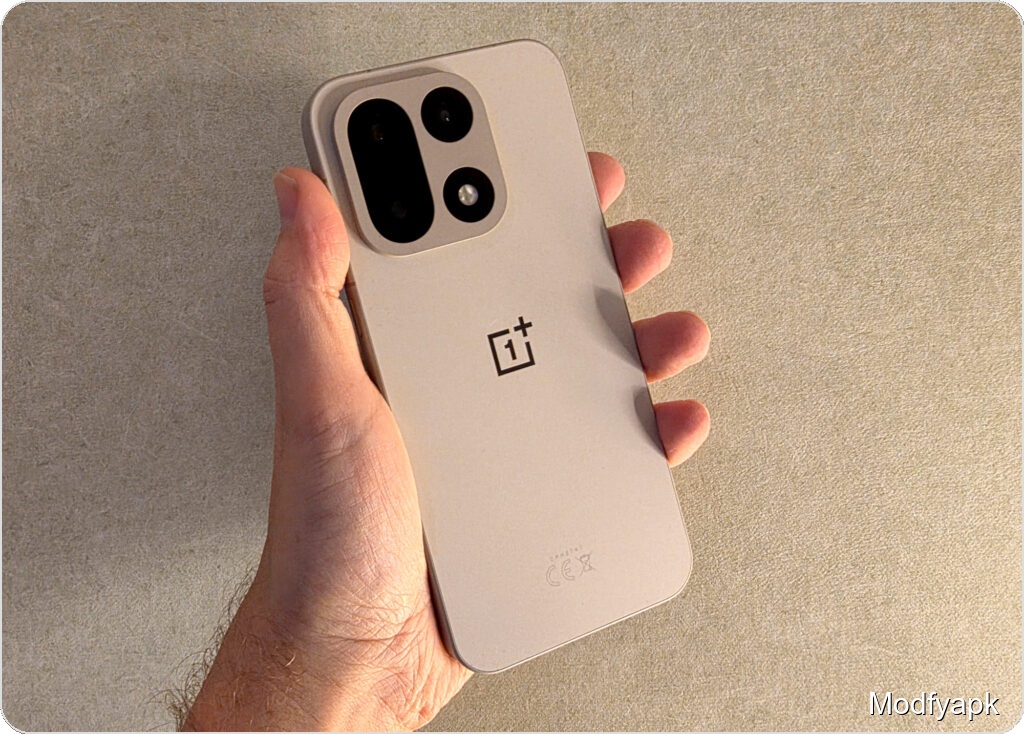
The OnePlus 15 follows the OnePlus 13 and ships in three finishes: Infinite Black, Sand Storm and Ultra Violet. Sales began in mid-November with a starting price of 949 euros for the 12 + 256 GB model; the review unit is the 16 GB RAM, 512 GB storage configuration priced at 1,099 euros.
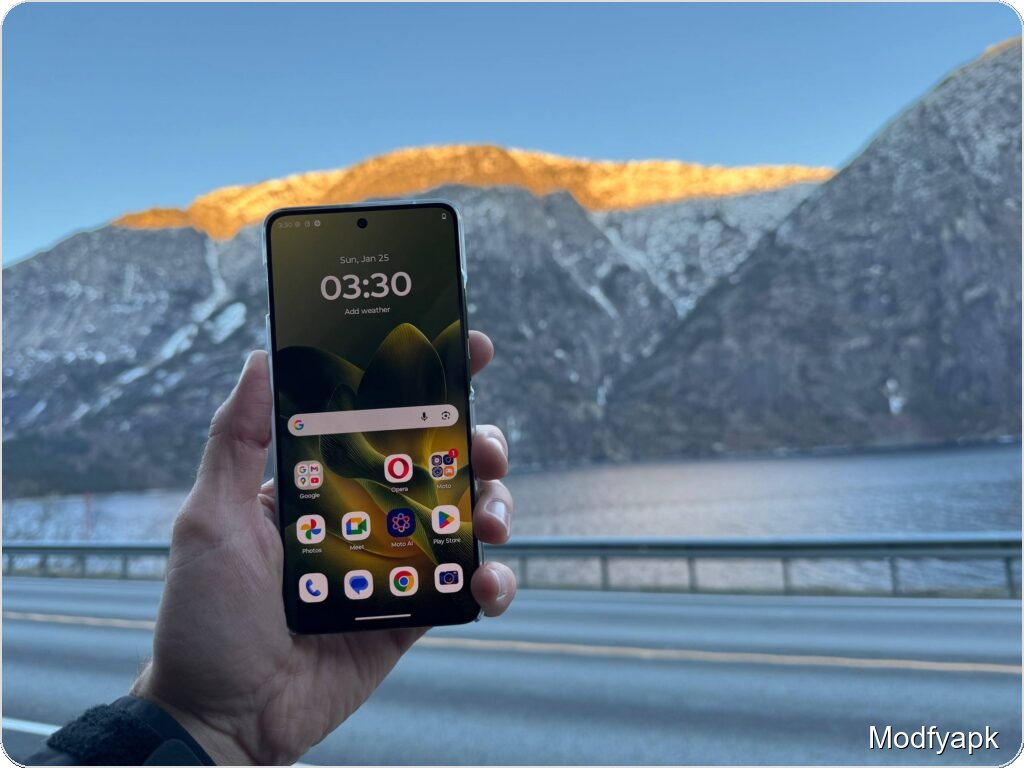
The handset is a large device at 161.4 x 76.7 x 8.1 millimeters (8.2 mm for colors other than Sand Storm) and weighs 211 grams in the review color (215 grams in the other finishes). Its size and mass sit at the heavyweight end of the flagship class, comparable to the Samsung Galaxy S25 Ultra.
Despite the hefty specs on paper, the phone’s center of gravity is well balanced, so it feels less top-heavy than its weight suggests. At just over eight millimeters thick, it is slim for its class.
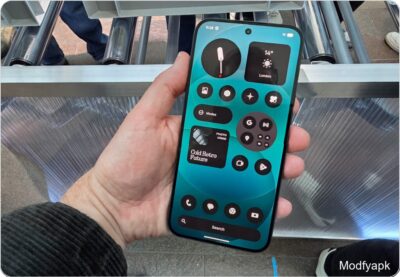
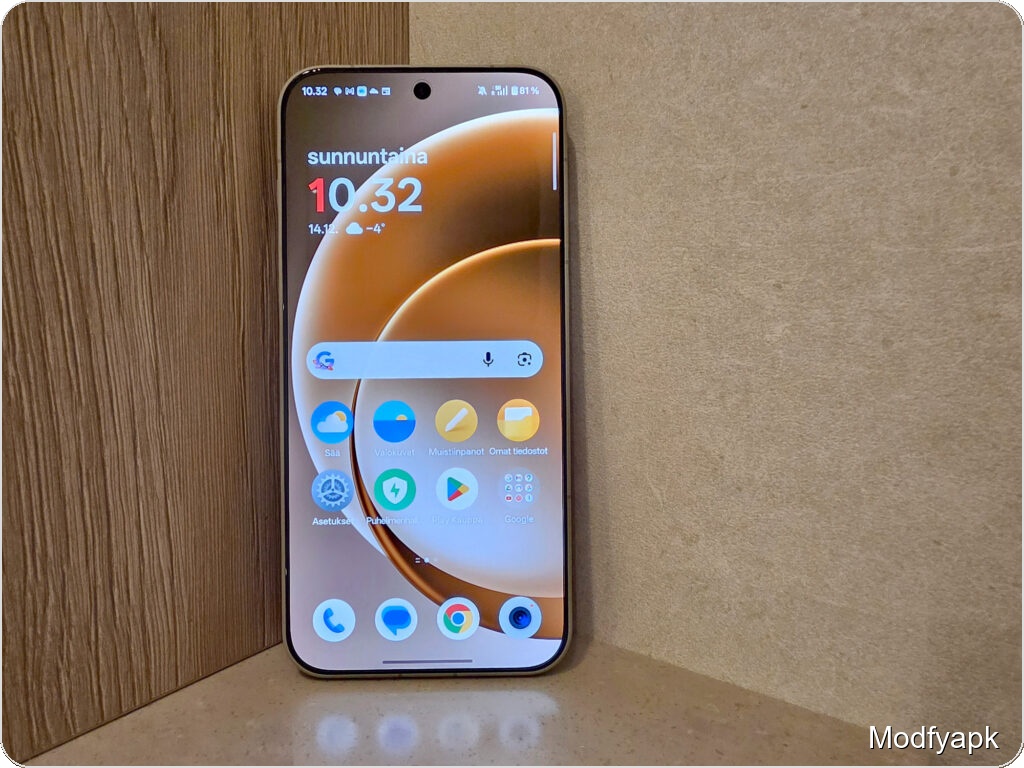
The design departs from OnePlus’s earlier softer shapes in favor of flatter planes and sharper edges that are now common across several manufacturers. The finishing is very high quality. A metal frame wraps the chassis with a matte finish that adds grip, but the back panel remains slick, so a case is still advisable.
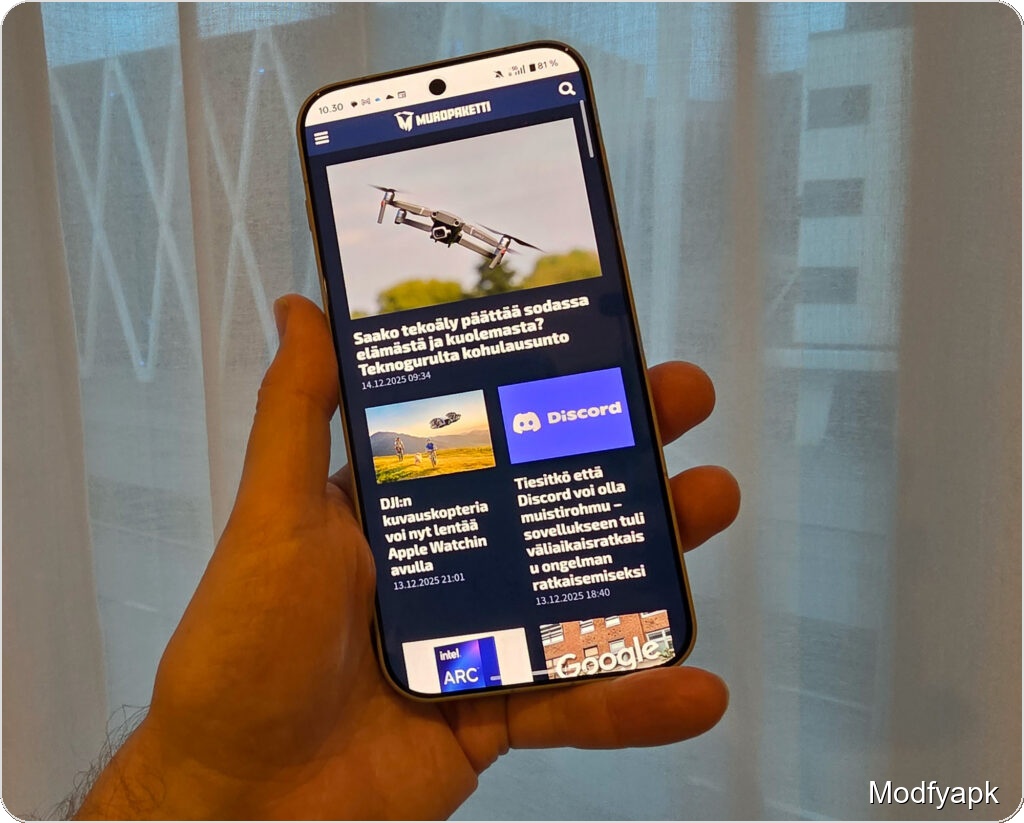
Bezels are impressively thin at 1.15 millimeters, and the display surface is largely flat with minimal curvature at the very edge. A hole punch houses the front camera and an in-display ultrasonic fingerprint sensor sits low on the screen; the fingerprint reader is fast and reliable. Face unlock is available but not as secure as the fingerprint sensor.
For protection, OnePlus 15 gains a full set of ingress ratings: IP66, IP68, IP69 and IP69K, improving on the predecessor by adding IP69K. The phone is rated to survive exposure to high-pressure water up to 80 degrees Celsius and immersion to two meters for 30 minutes.
Physical controls include a power button and a wide volume rocker on the right edge positioned relatively high. On the left, OnePlus replaces its longtime three-position alert slider with a programmable Plus Key. The new button is configurable but currently relies on OnePlus’s presets and feels less immediately useful than the old slider to long-time users.
The bottom edge houses the speaker, microphone, USB-C port and SIM tray. OnePlus gives the audio setup a nod: volume is loud and clear even at higher levels.
Display
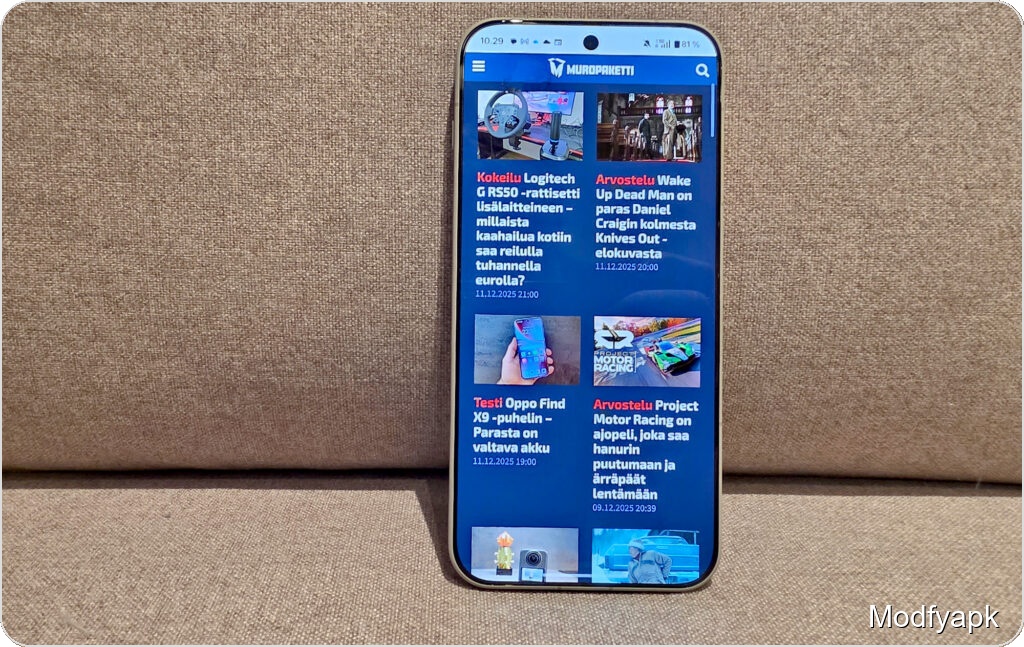
The OnePlus 15 uses a 6.78-inch LTPO AMOLED with a native resolution of 2772 x 1272 pixels. That panel is slightly smaller and nominally lower-res than the predecessor. The phone offers an auto-resolution mode that switches between full resolution and a 2354 x 1080 standard mode; in practice the step down is not noticeable in normal use.
Peak brightness is rated at 1,800 nits, a meaningful drop from the previous model’s 4,500 nits. For everyday use the screen is plenty bright, but the lower peak can show up with some HDR10+ or Dolby Vision material.
Where the display improves is refresh rate: OnePlus pushes to a maximum of 165 Hz. That peak rate is only available in supported games, but the panel is smoothly responsive across typical refresh ranges. The default color tuning is restrained and natural, and contrast is excellent.
The phone ships with a virtually invisible preinstalled screen protector, and the display uses 2,160 Hz PWM dimming for comfortable low-brightness use. OnePlus also adds a Motion Signals feature that overlays visual cues tied to acceleration and turning to help mitigate motion sickness.
Software and new controls
OxygenOS 16, built on Android 16, powers the OnePlus 15. The shell is fast and fluid, with polished transitions and a modern look that still shows ties to Oppo’s ColorOS. App drawers, recent apps and navigation gestures behave as expected.
OnePlus promises four major OxygenOS version upgrades and six years of security updates. That commitment is reasonable but lags behind Samsung’s and Google’s seven-year promises.
The Plus Key is the headline software addition. It is designed to surface Plus Mind, OnePlus’s contextual AI layer, though the button can be mapped to other actions. Plus Mind attempts to gather items a user may want to deal with later and organize saved screen content. In testing the feature felt immature and not consistently useful, though heavy users might find value as OnePlus evolves the software.
OxygenOS 16 also brings AI-powered tools to the Gallery app, including anti-reflection fixes. The phone now supports file sharing with Macs and cross-device proximity transfer to iPhones similar to Android peers.
Cameras
OnePlus has ended its Hasselblad partnership for this model. The camera hardware is a triple 50-megapixel lineup: a main 50 MP Sony IMX906 (1/1.56″, f/1.8, OIS), a 50 MP telephoto camera with a 3.5x periscope Isocell JN5 sensor (1/2.76″, f/2.8, OIS) and a 50 MP ultrawide (Samsung S5KJN5, 1/2.88″, f/2.0) with a 116-degree field of view and autofocus for macro work.
OnePlus introduces a DetailMax Engine algorithm that can produce 26 MP outputs, although typical pixel-binned images are 12.5 MP. In practice the algorithm appeared sporadically and most photos defaulted to 12.5 MP results.
In daylight all three cameras are competent, but the main camera shows weaknesses in exposure and dynamic range that do not always land correctly. Images often show noticeable sharpening and occasionally look overprocessed. Results vary from very good to clearly flawed shot to shot, which forces you to double-check captures.
The ultrawide lags the main camera in color fidelity, sharpness and dynamic range even in good light. The tele performs reasonably well at optical zoom with tones close to the main camera, but its autofocus is not the quickest.
Low-light performance drops off more significantly. While the primary camera can still occasionally pull acceptable shots in dim scenes, ultrawide and tele struggle, with aggressive noise reduction leading to soft images and reduced dynamic range. Overall low-light image quality sits closer to high-tier midrange competitors than the top flagships.
Video capture on the main camera is strong in bright conditions. The OnePlus 15 records 8K/30fps on the main sensor and 4K/120fps. Other modules record up to 4K/60fps. Main-camera footage is detailed, well stabilized and has natural color and solid dynamic range. Secondary cameras degrade noticeably in low light.
Performance and thermal behavior
The OnePlus 15 is the first phone we tested with Qualcomm’s new Snapdragon 8 Elite Gen 5. The octa-core SoC is built on a 3 nm process and pairs two 4.6 GHz Oryon V3 Phoenix L cores with six 3.62 GHz Oryon V3 Phoenix M cores, and an Adreno 840 GPU.
Day-to-day performance is excellent. App launches and general navigation are buttery smooth, and the UI maintains consistent responsiveness even under heavier tasks. The phone does warm under sustained synthetic workloads, but OnePlus’s 360 Cryo-Velocity Cooling appears effective; the device never got uncomfortably hot. The cooling system includes a 5,731 mm² vapor chamber and aerogel-based display cooling.
In benchmark comparisons against Oppo Find X9 (Dimensity 9500), Google Pixel 10 (Tensor G5), Samsung Galaxy S25 (Snapdragon 8 Elite for Galaxy), Honor Magic7 Pro (Snapdragon 8 Elite) and OnePlus 13 (Snapdragon 8 Elite), the OnePlus 15 led recent rivals in CPU- and system-level tests by more than a 10 percent margin in GeekBench 6 and scored highest on AnTuTu, with Oppo Find X9 trailing behind. GFXBench results placed it among the top performers but not decisively ahead of every prior-generation flagship, which reflects the limitations of some legacy graphics tests. PCMark Work testing produced unexpected results where the newest devices sometimes ranked lower.
Battery and charging
OnePlus fits a 7,300 mAh battery in the 15, using silicon-carbon cell technology for higher energy density. That is a large capacity for a device this size; the predecessor was 6,000 mAh.
Battery life is exceptional. In our testing the OnePlus 15 ran 1,374 minutes (about 22.9 hours) in a mixed workload test, comfortably ahead of the competition and well beyond the previous model. In real-world travel use—concurrent roaming, heavy photo and video capture and continuous navigation—the phone easily lasted a full day with headroom. Lighter users can expect two days and, for very light use, even three.
OnePlus supports very fast wired charging with its optional 120 W SuperVOOC charger. Charging speed is impressive: 20 percent in five minutes, 50 percent in 15 minutes, 70 percent in 24 minutes, 90 percent in 34 minutes and 100 percent in 43 minutes.
Without the proprietary brick the phone accepts USB Power Delivery at up to 55 W. Wireless charging is supported at up to 50 W with OnePlus’s AirVOOC charger, and the phone supports a magnetic accessory ecosystem that requires a magnet-containing case.
Summary
OnePlus 15 is, in short, a very capable flagship. Its strengths are unmistakable: top-tier performance, class-leading battery life, refined build and a very good display. These attributes make it an easy daily driver where battery life and speed matter most.
But OnePlus did not deliver across the board. Camera results are inconsistent and fall behind the very best in low light. The replacement of the classic three-position alert slider with a programmable button will disappoint loyalists. And the four major OS upgrades with six years of security updates trail the longer commitments other vendors now offer.
At roughly 1,000 euros, the OnePlus 15 is not cheap. Still, with outstanding endurance, excellent performance and top-tier fit and finish, it remains a compelling option for buyers who prioritize those strengths.
Pros: premium build, exceptional battery life, excellent performance, strong display, very fast charging.
Cons: removal of the alert slider, camera weaknesses, modest OS upgrade promise, large for smaller hands.
| Price | 949 € (12 GB + 256 GB), 1,099 € (16 GB + 512 GB) |
| SoC / GPU | Qualcomm Snapdragon 8 Elite Gen 5 (2 x Oryon V3 Phoenix L and 6 x 3.62 GHz Oryon V3 Phoenix M), Adreno 840 |
| OS | OxygenOS 16 (based on Android 16) |
| Display | 6.79″ LTPO OLED, 2772 x 1272, 20:9, 1–120 Hz and 165 Hz, 1,800 nits peak, HDR10+ |
| Cameras | 50 MP main (Sony IMX906, 1/1.56″, f/1.8, OIS), 50 MP tele (3.5x periscope, 1/2.76″, f/2.8, OIS), 50 MP ultrawide (Samsung S5KJN5, 1/2.88″, f/2.0) |
| Connectivity | SIM, LTE, 5G, Wi‑Fi 7, Bluetooth 6.0, NFC, USB-C 3.2 Gen 1 |
| Battery / Charging | 7,300 mAh, 120 W wired, 50 W wireless |
| Dimensions / Weight | 161.4 x 76.7 x 8.1–8.2 mm, 211–215 g |
| Other | In-display ultrasonic fingerprint sensor |