Introduction
Samsung’s Galaxy S25 Edge arrives as one of the earliest examples of a trend toward thinner, lighter flagship phones. The design shows a clear point: you can have a large display and still hold a handset that feels pleasantly light. That benefit comes with trade-offs, and the phone is far from cheap.
Market context and launch
Phone sizes and weights have crept up in recent years, and this year looks like the start of a push back toward slimmer devices. Samsung was first with a mainstream thin-and-light flagship, and Apple is expected to respond with an iPhone 17 Air model that emphasizes a slimmer silhouette. If the big players follow, this could become a genuine direction for flagship design, with other makers likely to join.
The Galaxy S25 Edge was officially announced on May 13 and went on sale later that month. Samsung lists the 12+256 GB model at 1,349 euros and the 12+512 GB model at 1,499 euros. Color options are Titanium Silver, Titanium Jetblack, and Titanium Icyblue; the review unit was the blue finish.
Where the Edge fits in the lineup
Samsung’s S25 family already includes the Galaxy S25, S25+, and S25 Ultra. The Edge is a new addition that slots in pricing between the original S25+ and S25 Ultra launch prices. Other S25 variants that hit stores in January are already being sold at noticeably lower prices, and in some cases the Ultra can be found cheaper than the new Edge.
This lighter review focuses on what sets the Edge apart from its siblings: its thinness, its two-camera rear setup, and battery life. Performance testing was also lighter than in full reviews. Software is broadly the same as other S25 models, including the suite of AI features covered in previous S25 reviews. Samsung’s update promise remains the same: seven OS upgrades and seven years of security updates.
Box contents
The retail package is consistent with the rest of the line: the phone, a USB-C cable, warranty and docs, and a SIM tool. As before, a charging brick is not included.
Design and in-hand feel
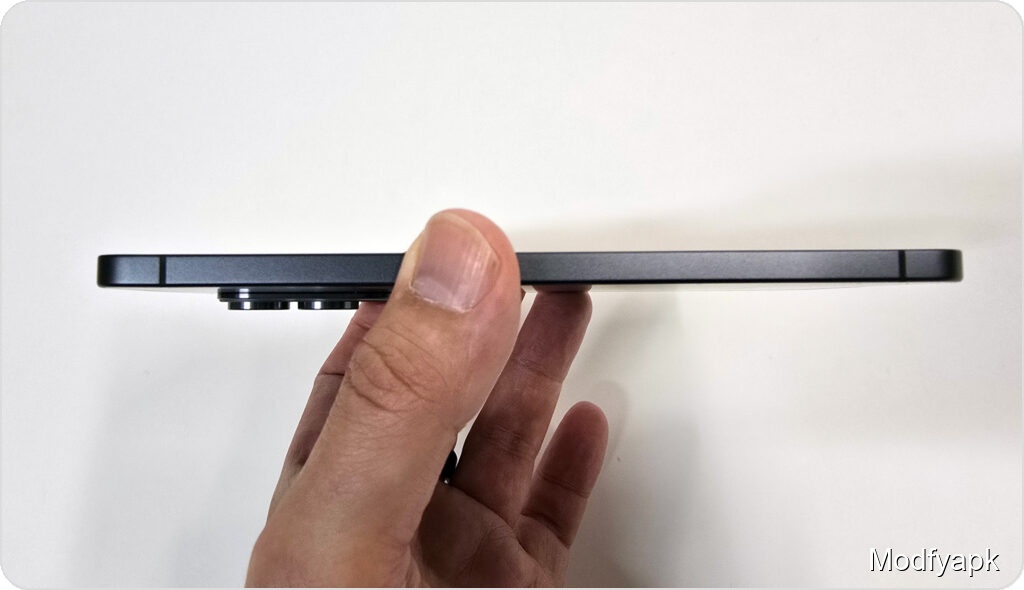
The headline spec is the chassis thickness: the S25 Edge measures just 5.8 millimeters. That sounds small on paper, but compared with the S25+ — which is 1.5 mm thicker — the difference is obvious in the hand. Even side-by-side with the 8.2 mm S25 Ultra, photos do not fully convey how much slimmer the Edge feels.
Thinness brings a protruding camera bump. Roughly speaking, the phone thickens by about 1.5 times at the camera island.
In daily use the Edge surprised in a good way. The slim frame makes the phone easier to grip than its larger siblings, and its recorded weight of 163 grams is striking. After using the 218-gram Ultra, the 55-gram difference is unmistakable; the Edge feels almost floaty and can be manipulated more comfortably one-handed.
Display and audio
The Edge uses the same 6.7-inch panel as the S25+ with an LTPO AMOLED at 1440 x 3120 resolution and a 1–120 Hz variable refresh rate. Peak brightness is not specified, but real-world use showed the screen performs nearly as well in direct sunlight as the Ultra. Color reproduction and contrast are flagship-class.
Audio comes from stereo speakers, but the slim enclosure limits loudness and body, so sound is a bit thin. The in-display fingerprint sensor worked reliably and quickly.
Durability
Thin phones raise durability questions, but Samsung built the Edge with a titanium frame and used Gorilla Glass Victus 2 on the back and Gorilla Glass Ceramic 2 on the front. It also passed a bend test by JerryRigEverything, indicating the slim profile does not compromise structural integrity.
Battery life and charging
The trade-off for thinness is battery capacity. The Edge packs a 3,900 mAh cell, which is small for a flagship. By comparison, the S25 has a 4,000 mAh pack and the S25+ is 1,000 mAh larger.
On a full day with heavy use, including lots of photos and roaming, the Edge finished the day with just over 20 percent remaining. Typical days tended to land around the 50 percent-ish range. That means the phone comfortably covers an active single day but is unlikely to reach a reliable second day without very light use.
Muropaketti’s standardized battery test returned 695 minutes, one of the weaker recent results and a clear indicator of the smaller battery. Charging speeds are modest as well: the phone accepts up to 25 W wired. A full charge from zero took 76 minutes, 50 percent arrived in 27 minutes, and 80 percent in 47 minutes. Those numbers are underwhelming compared with sibling models that support 45 W charging.
Cameras
The Edge has only two rear cameras: a 200 MP main sensor and a 12 MP ultrawide with autofocus. That slim camera stack is the phone’s thickest point and makes the handset rock when laid flat.
The main camera shares the same 1/1.3-inch 200 MP sensor found in the Ultra (f/1.7, OIS, PDAF). It performs excellently, delivering natural colors, solid dynamic range, and strong low-light capability. The in-app 2x crop is a sensor crop rather than a true telephoto zoom, but it is serviceable and will satisfy many users who rarely rely on long-range zoom.
The ultrawide uses a 12 MP sensor familiar from the more affordable S25 variants, now with autofocus for close shots. In good light it does a fine job and matches color tones reasonably well with the main camera, but it falls behind on resolution and softens noticeably in low light.
The front camera is the same unit across the S25 family and delivers solid results in both bright and dim conditions. Video capture is strong in resolution and stabilization, though color tuning can occasionally be a touch aggressive.
Performance
The Edge runs on the Qualcomm Snapdragon 8 Elite for Galaxy with an Adreno 830 GPU and Android 15 with One UI 7.
Benchmark scores from the review unit were:
- Antutu: 1,432,770
- Geekbench: 2,449 single-core / 8,882 multi-core
- PCMark: 20,061
These numbers are close to earlier S25 and S25 Ultra results. The Edge trailed slightly in Antutu but otherwise delivers near top-tier performance.
Verdict
The Galaxy S25 Edge is a compelling demonstration that a large-screen handset can be remarkably light and thin. The design excels at in-hand comfort and makes one-handed use easier than with heavier models.
Those advantages come with measurable compromises. The lack of a dedicated telephoto camera module and the smaller battery with slower charging will matter to some users. For people who primarily shoot with the main camera and value portability, the Edge is a very attractive option. For Ultra users who need top-of-the-line camera hardware and maximum battery life, the trade-offs may be too large.
Higher pricing also limits the Edge’s mainstream appeal, at least initially. If more manufacturers adopt this thin-and-light approach and competition grows, prices may ease. Until then, in markets like Finland, the sales mix will likely remain tilted toward medium and larger phones.
Ultimately, the S25 Edge’s charm is best experienced in person: pictures and specs only tell part of the story.
Pros and Cons
Good
- High-quality build
- Delightful lightness
- Excellent display
- Strong update promise
Bad
- Slow charging
- No telephoto camera
- Price
Specifications
| Price | 1349 € (12+256 GB), 1499 € (12+512 GB) |
| Chipset / GPU | Qualcomm Snapdragon 8 Elite for Galaxy, Adreno 830 |
| OS | Android 15, One UI 7 |
| Display | 6.7″ LTPO AMOLED, 19.5:9, 1440 x 3120, 1–120 Hz |
| Cameras | 200 MP main (f/1.7, OIS, PDAF) + 12 MP ultrawide (f/2.2, PDAF), 12 MP front (f/2.2), video up to 8K@30fps (main) |
| Connectivity | Dual SIM (nano), LTE, 5G, WiFi 7, Bluetooth 5.4 |
| Ports | USB Type-C (USB 3.2 Gen 1) |
| Battery | 3900 mAh, 25 W wired, 15 W wireless, reverse wireless charging |
| Dimensions / Weight | 158.2 x 75.6 x 5.8 mm, 163 g |
| Other | In-display fingerprint, IP68, stereo speakers |