Overview
The Samsung Galaxy S26 Ultra is the company’s flagship with few clear weaknesses. It continues the brand’s tradition: stronger performance, refined cameras and a modern but familiar design. Samsung’s generous update promise also remains intact.
That makes this phone aimed squarely at users who demand top-tier speed, high-quality cameras and a device they can keep using for years.
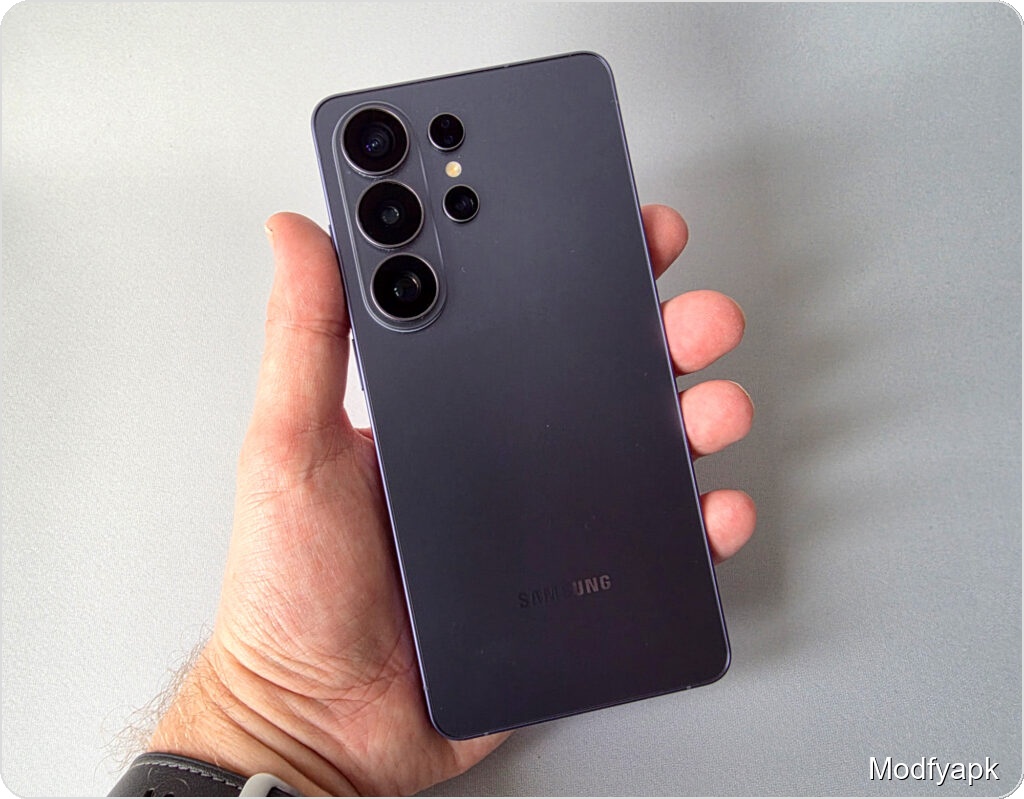
The S26 Ultra ships in three memory configurations: 12 GB RAM with 256 GB storage, 12 GB with 512 GB, and 16 GB with 1 TB. Color options are black, cobalt violet, sky blue and white.
Prices have edged up from last year except for the base model. The starting price is 1,499 euros for 12 + 256 GB, the mid tier is 1,699 euros, and the top 16 GB / 1 TB model costs 1,999 euros.
Packaging
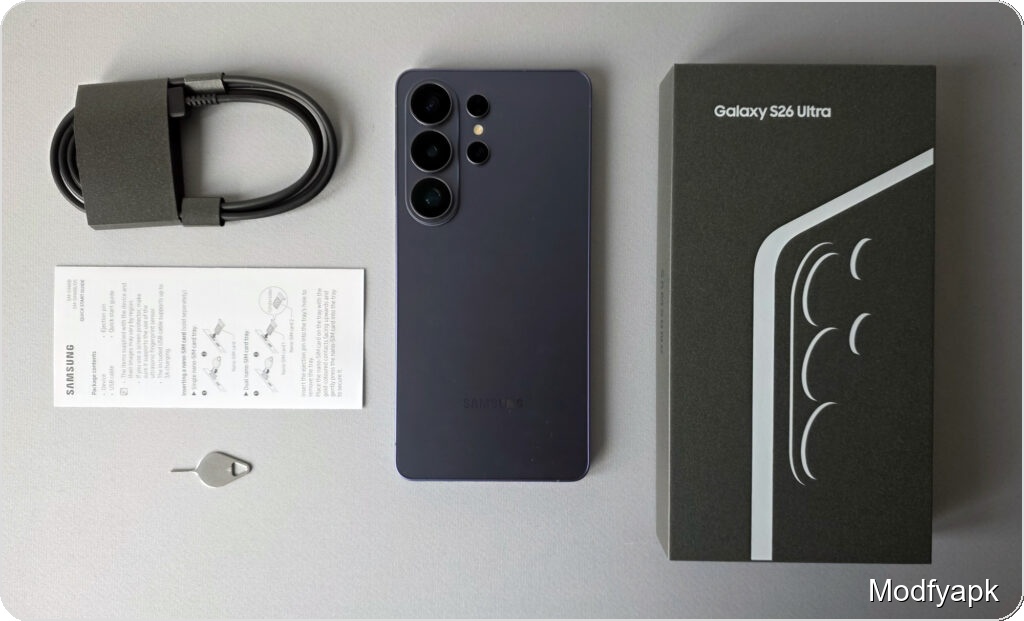
The sales package is minimal. Inside the box you get only the phone and a USB-C to USB-C cable. You must buy the charger separately, and there is no protective case included.
Design and build
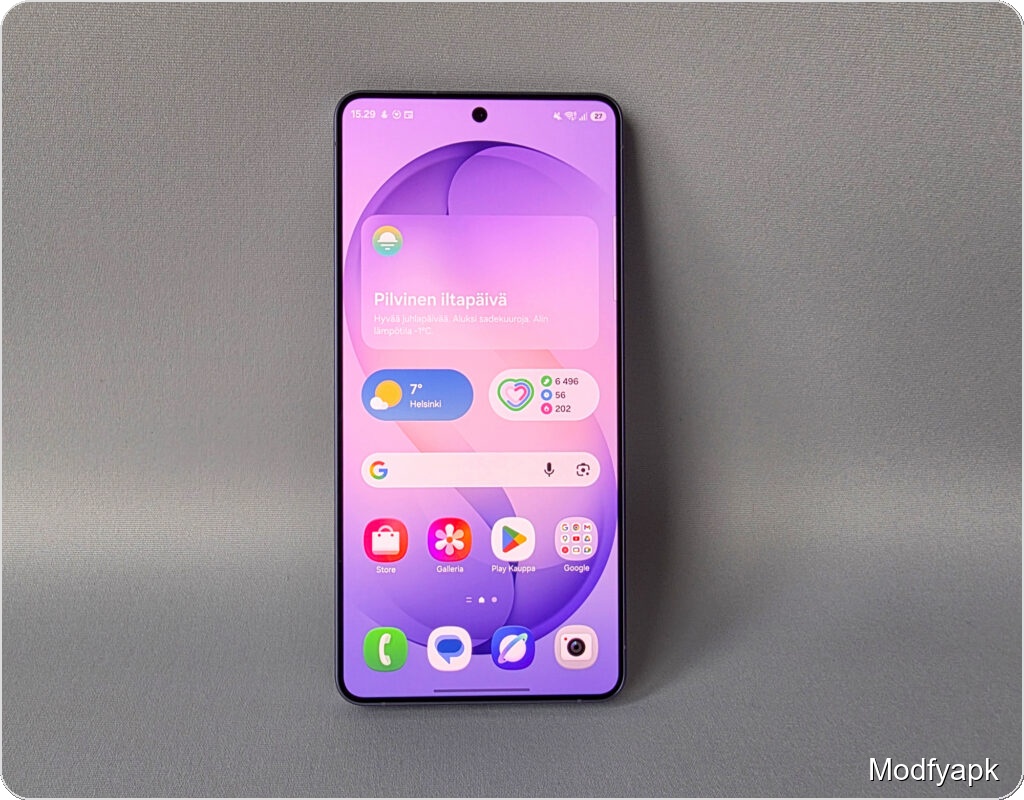
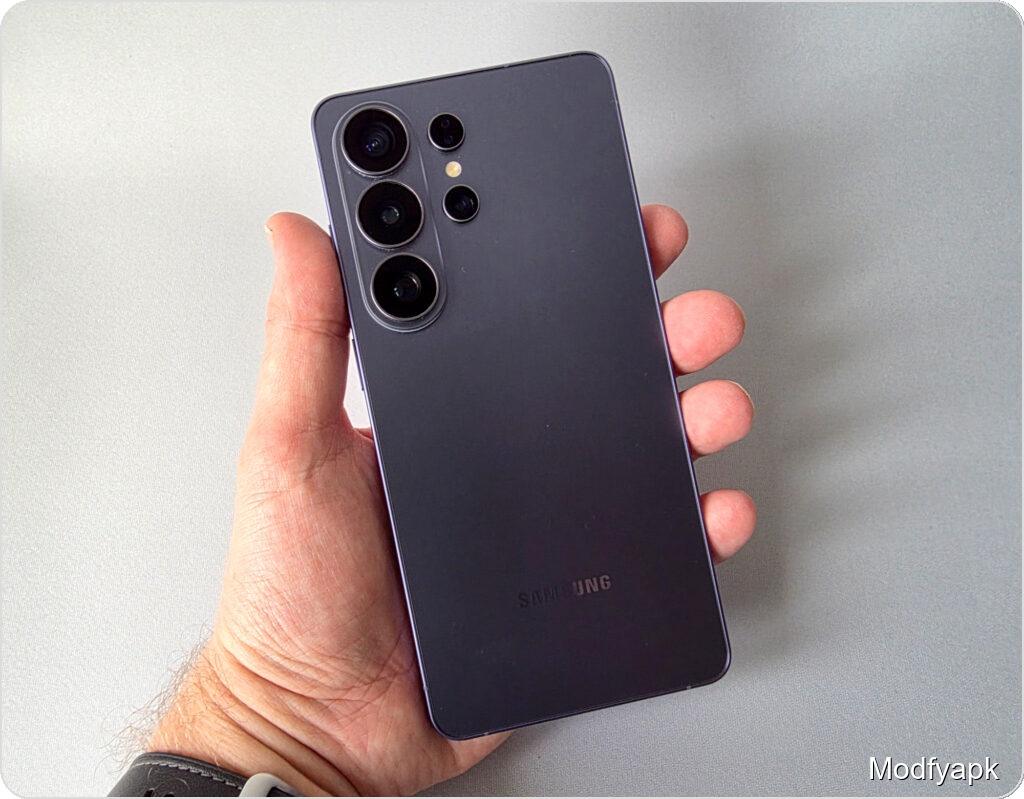
The Galaxy S26 Ultra looks familiar, following the same visual language as last year’s models and the current S26 and S26+. Rounded corners and flat sides define the look. Ultra-specific cues include a slightly different camera module and the S Pen tucked into the bottom.
Samsung uses an aluminum frame and Gorilla Armor2 glass on both sides, producing a well-finished, durable build. The phone measures 163.6 x 78.1 x 7.9 mm and weighs 214 grams. It is slightly taller and wider than its predecessor but one millimeter thinner, and four grams lighter. It carries an IP68 rating.
This is a very large phone by design. Narrow bezels help, but the size will be too big for some users. The phone feels reasonably balanced, but its straight edges make it slippery without a case, so buying one is sensible given the price.
All physical buttons sit on the right edge: the power/assistant button lower and the volume rocker above it. The layout is sensible, although users with smaller hands may need to stretch for the volume key. The bottom houses a USB-C port, a dual-SIM tray and the S Pen. The pen itself is narrower than before, feeling thin in bigger hands and only seating correctly one way in the slot.
Camera lens rings now match the chassis color, and the lenses sit on a shared bump, so older protective cases do not fit despite unchanged outer dimensions.
Display and unique privacy feature
The S26 Ultra has a 6.9-inch QHD+ Dynamic AMOLED 2X display with a 1–120 Hz adaptive refresh rate and a peak brightness of 2,600 nits. Samsung’s Vision Booster helps maintain readability in bright conditions, and HDR10+ support ensures strong color and contrast for streaming.
What sets this model apart is a built-in Privacy Display. When activated, it prevents clear viewing from side angles and from above or below. The intensity is adjustable, and you can limit it to specific apps or notifications. At maximum strength image colors can shift and look muted, but when viewed straight on the screen behaves normally. The privacy effect is less extreme than on the previous model at extreme angles, and in very dim scenes the display can hunt for the correct brightness. With the highest privacy setting enabled images may appear grayer than usual.
Overall the privacy screen works well and could be useful on laptops someday, potentially replacing separate privacy films. For now it is exclusive to the Galaxy S26 Ultra among the S26 lineup.
The in-display ultrasonic fingerprint reader sits at a practical height and unlocks reliably and quickly. Stereo speakers sound very good for a smartphone and support Dolby Atmos.
One UI continues to build on Android 16 with features centered around on-device AI. Gallery and Creative Studio gains more editing and sorting tools. A noteworthy new tool is Sound Remove, which isolates prominent audio from noisy videos — our quick tests found it surprisingly effective. Google Gemini agent features are coming to the phone, but their availability remains limited, and Samsung’s Bixby can still be used to control Samsung apps, although it lacks Finnish language support.
Samsung’s update promise remains a standout: seven major OS updates and seven years of security patches, extending at least to early 2033.
Cameras
Ultra models have long been defined by their camera systems, and the S26 Ultra keeps that approach. Lens placement has been regrouped into a single island, but the hardware is familiar.
The main sensor is a 200 MP unit with an f1.4 aperture and a 1/1.3-inch sensor size. It offers optical image stabilization and pixel-binning. The ultrawide is a 50 MP sensor with an f1.9 aperture and a 120-degree field of view; it also supports autofocus and macro shots.
There are two telephoto lenses. A 10 MP sensor provides 3x optical zoom with an f2.4 aperture and OIS. A 50 MP periscope sensor delivers 5x optical zoom and uses an f2.9 aperture with OIS. The front camera is 12 MP with an f2.2 aperture and Dual Pixel AF. Video tops out at 8K 30 FPS.
The main camera performs very well: detailed images with natural colors, balanced dynamic range and restrained sharpening. 2x crops look processed at times, even in good light, and the nearest focus distance has increased slightly. Night mode engages automatically and preserves good dynamics and color, though images are softer in low light.
The ultrawide is also strong, matching the main camera’s color and dynamic behavior. Both shorter telephoto camera shots and the longer periscope images are the weak points. The 3x camera sometimes produces a harsher, grainier look than the main sensors. The 5x periscope aligns colors better with the other lenses and yields a touch more detail, but aggressive sharpening appears in some images. Low-light telephoto camera shots are softer and grainier.
The front camera delivers sharp, natural results even in relatively low light. Overall, the Ultra cameras remain capable and versatile with solid night shooting and long zoom, but competitors are closing the gap, so Samsung cannot be complacent.
Video and stabilization
Video capture is a clear strength. Image quality is excellent in bright conditions and still acceptable in lower light. Stabilization works very well, and a new horizon lock feature keeps the horizon steady in both landscape and portrait videos. It is impressively effective.
Performance and benchmarks
The S26 Ultra runs Qualcomm’s Snapdragon 8 Elite Gen 5 for Samsung Galaxy with an Adreno 830 GPU. That secures top-tier performance for gaming, AI tasks and multitasking. Our review unit had 12 GB of RAM; the highest-end model includes 16 GB.
We compared the phone to Motorola Signature (Snapdragon 8 Gen 5), Honor Magic8 Pro (Snapdragon 8 Elite Gen 5), OnePlus 15 (Snapdragon 8 Elite Gen 5), Google Pixel 10 (Tensor G5) and Samsung Galaxy S25 (Snapdragon 8 Elite for Galaxy).
In GeekBench 6, which stresses CPU and GPU across single- and multi-threaded workloads and AI acceleration, the new Samsung edged into first place on multi-core scores but trailed the Honor Magic8 Pro on single-core performance. The OnePlus 15 was close behind; the Pixel 10 lagged noticeably.
AnTuTu, which emphasizes 3D rendering, placed OnePlus 15 first and had a tight race for second. Honor Magic8 Pro narrowly beat the Galaxy S26 Ultra, with Motorola Signature and the earlier Galaxy S25 trailing. Pixel 10 was last here as well.
In 3DMark Solar Bay and Wild Life Extreme, OnePlus 15 and Honor Magic lead, with the S26 Ultra right behind. The older Galaxy S25 and Motorola Signature trailed by a step. Pixel 10 did not complete the Solar Bay run.
PCMark Work, which stresses everyday tasks such as web browsing, video editing and photo editing, again put Honor Magic8 Pro on top. Samsung’s newer S26 Ultra and the S25 followed, with Motorola Signature fourth and OnePlus 15 surprisingly in fifth.
Battery and charging
The S26 Ultra has a 5,000 mAh battery. In daily use the battery is adequate but not class-leading. In our battery endurance test the S26 Ultra underperformed its predecessor, though that test is not optimized for the newest phones and may skew results. Across two weeks of review use, heavy usage often left the battery in the 20–30 percent range by the end of the day, so two full days on a single charge is unrealistic for most power users.
Charging has improved. The phone supports 60 W wired fast charging. Using Samsung’s 60 W charger we measured 30 percent in 8 minutes, 50 percent in 15 minutes, 80 percent in 30 minutes and a full charge in 48 minutes. That pace should satisfy most users. The phone also supports 25 W wireless charging and reverse wireless charging.
Summary
The Samsung Galaxy S26 Ultra remains a top-tier flagship. It blends a strong camera system, a large and excellent display and class-leading performance. Seven years of software and security updates is an industry-leading promise, and the sturdy construction gives confidence in durability. Faster 60 W wired charging is welcome, though battery capacity and endurance could use improvement.
Two standout features may decide buyer preferences: the built-in S Pen for those who use a stylus, and the display’s Privacy mode, which could be a decisive advantage for business users or anyone worried about shoulder surfing.
Overall changes are modest. Owners of one- or two-generation-old Ultra models have little compelling reason to upgrade immediately.
Pros and cons
Pros
- Performance
- High-quality display
- Focus on display privacy
- Premium build
- Improved charging speed
- S Pen differentiator
Cons
- Incremental updates
- Battery capacity and endurance lag competitors
- Gets hot under heavy load
Specifications
| Price | 1499 / 1699 / 1999 € (256 GB / 512 GB / 1 TB) |
| Chipset | Snapdragon 8 Elite Gen 5 for Samsung Galaxy, Adreno 830 |
| Memory / Storage | 12 GB (256 / 512 GB), 16 GB (1 TB) |
| Display | 6.9″ Dynamic AMOLED 2X, 3120 x 1440, 505 PPI, 1–120 Hz, up to 2600 nits |
| Rear cameras | 200 MP main (f1.4, OIS), 50 MP ultrawide (f1.9, 120°), 10 MP tele 3x (f2.4, OIS), 50 MP tele 5x (f2.9, OIS); video up to 8K 30 FPS |
| Front camera | 12 MP (f2.2, Dual Pixel AF) |
| Battery | 5000 mAh, 60 W wired fast charging; also 25 W wireless and reverse wireless charging |
| Connectivity | LTE, 5G, Wi‑Fi 7, Bluetooth 5.4, USB‑C 3.2 |
| Operating system | Samsung One UI 8.5 (Android 16) |
| Dimensions / Weight | 163.6 x 78.1 x 7.9 mm, 214 g |
| Other | In-display ultrasonic fingerprint reader, face unlock, stereo speakers, Dolby Atmos, IP68, S Pen |