Overview
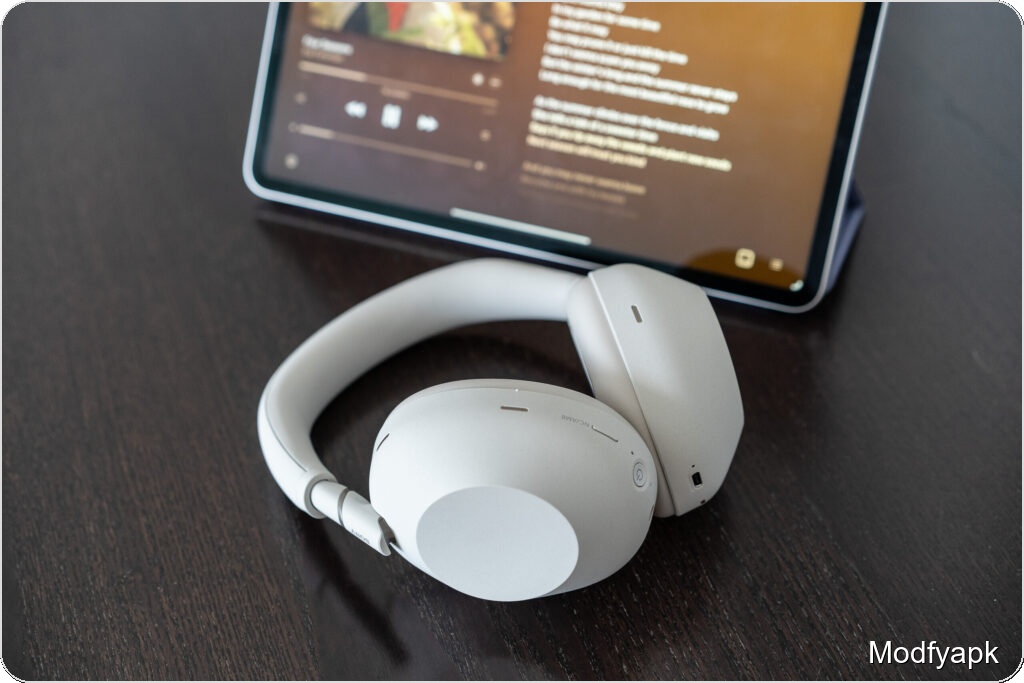
Sony’s WH-1000X M6 keeps you lost in music for hours. The headphones raise noise cancellation to a new level, creating a quiet personal bubble even in loud places. Hands-free calls remain usable in situations as noisy as a concert.
Lineage and What’s New
The WH-1000X M6 marks the sixth generation of Sony’s flagship noise-canceling headphones. The previous M5 model arrived in 2022, so this is a long-awaited update. Sony’s experience with active noise cancellation stretches back nearly a decade to the original MDR-1000X in 2016.
New this generation: the cups fold into a case. The included case now seals with a magnet instead of a zipper, making it faster to stow the headphones. The case holds a short USB-C charging cable and an analog headphone cable.
Fit and Comfort
The headband and ear pads are wrapped in soft synthetic leather that feels comfortable against the skin. The memory-foam-style cushions are very compliant. They form a tight seal around the ears without pressing uncomfortably on the head, so you can wear them for extended sessions. Over long stretches you do notice some warmth around the ears, but not enough to make the headphones unpleasant to use.
Notably, the M6s work very well with eyeglasses. temple arms sink into the padding cleanly and changes in sound or noise-canceling performance are minimal compared with listening without glasses. That is a clear advantage over many rivals.
Reference-Level Noise Cancellation
The standout feature is the noise cancellation. Sony upgraded the headphones’ processor to the QN3 version, which the company says is seven times faster than the chip in the 1000X M5 from three years ago. Each earcup houses six microphones placed around it, for a total of 12 mics devoted to active noise cancellation.
For best results make sure the headphones sit snugly. In practice you should set the headband as low as is comfortable so the cups press firmly around the ears. That lets passive isolation aid the active system. The difference is audible immediately in noisy environments. At home you can wear them a bit looser; a tighter fit tends to emphasize bass.
The cancellation itself is excellent. Thanks to the faster processor the M6 does a better job removing higher-frequency noise than many competitors. Alongside low-frequency hum, voices and other mid-frequency sounds are suppressed effectively. In many situations the headphones could be used solely for noise cancellation, but most users will happily listen to music while the system eliminates distractions.
On airplanes the noise reduction is particularly strong. Only some high-frequency hiss remains, and its level is noticeably lower. That lets you enjoy music at a much lower volume than with other headphones and still feel isolated.
Clear Calls
The six microphones per earcup also improve call quality. Both sides benefit from the noise control: your voice and the other party come through surprisingly clearly. You can take calls in very noisy places, including concerts, and the person on the line will not hear most background noise. In testing the feature was genuinely impressive.
Beyond canceling noise, the headphones can also bring ambient sound in more clearly than wearing no headphones at all. You can lock that mode on with the noise-cancel button. A quicker option is to place your hand over the right earcup, which temporarily lets all outside sounds through for short conversations or announcements.
Detailed, Dynamic Sound
Sony’s tuning delivers detailed, precise sound that will satisfy discerning listeners. The M6 use 30 mm drivers updated from the M5. Out of the box the bass is elevated, which works well in noisy environments. You can tailor the frequency response with the app wizard or a manual 10-band EQ.
The headphones excel at detail and stereo separation. Dynamics are strong: bass is tight and impactful, while delicate high-frequency information remains clear. Instruments and elements sit distinctly in the soundstage, so long listening sessions were comfortable and engaging during testing.
Well-mixed tracks really shine. Familiar demo songs revealed new layers; for example, Laura Narhi’s “Asfaltin pinta” displayed full nuance, and raw rock like AC/DC’s “Let There Be Rock” retained its primal edge. Electronic music also benefits, with synth pads filling the soundscape convincingly.
On an iPhone using AAC, the difference between lossy and lossless masters was audible in dynamics and clarity. Sony’s DSEE Extreme setting can enhance playback; it worked well with lossless tracks and provided modest improvement on lossy files.
High-resolution wireless listening is limited to Android phones that support Sony’s LDAC codec, or by using the wired headphone jack plus an external DAC. The M6 do not support USB-C audio, so you cannot send fully lossless audio directly over the charging port.
Controls and App
Primary controls are on the headphones. The left earcup houses a round power button and an elongated noise-cancel button.
The right earcup surface responds to touch gestures. Double-tap plays and pauses. Swipe left or right to skip tracks. Swipe up or down to change volume. Unlike previous models, changing volume requires only a single swipe and holding your finger at the top or bottom until you reach the desired level.
Physical controls are complemented by the Sony Sound Connect app. The headphones support two connected devices at once. The app offers EQ presets and manual adjustment, finer control over the balance between noise cancellation and ambient sound, and customizable quick actions for the hardware buttons.
If you use different settings in different locations, the headphones can automatically switch profiles based on your phone’s GPS. Noise cancellation can also be set to react to external cues, such as when you start speaking.
Verdict
In testing the Sony WH-1000X M6 impressed with versatility, sound quality, and a new benchmark in noise cancellation. They are easy to fall for and feel like gear you can rely on for years. They are not an impulse buy at their price, but they bring features and performance you quickly come to appreciate.
Specifications
| Price | 450 EUR |
|---|---|
| Drivers | 30 mm |
| Frequency response | not specified |
| Noise cancellation | active + passive |
| Microphones | 12 |
| Supported codecs | SBC, AAC, LDAC, LC3 |
| Ports | USB-C (charging), 3.5 mm headphone |
| Connectivity | Bluetooth 5.3, Auracast |
| Battery life (claimed) | 30 h |
| Colors | black, silver, midnight blue |
| Weight | 254 g |
| App | Sony Sound Connect |