Introduction
Many people primarily use tablets for entertainment, and the Xiaomi Pad 5 is squarely aimed at that use. Priced under 500 euros, it packs a capable display, competent audio, and a surprisingly usable camera. The basics are all present, and no major flaws surfaced during testing.
Market context and availability
After years of decline, tablet sales turned upward last year. Longer device lifespans and demand for home office and leisure devices have manufacturers shipping new models again. One of this fall’s most interesting entries is the Xiaomi Pad 5, which launched on September 15 and hit stores soon after.
The Finnish market gets the 6 GB RAM / 128 GB storage variant. There is no microSD slot. The suggested retail price is 389 euros, although street prices hovered just above and below 400 euros at the time of writing.
That price puts the Pad 5 in the same neighborhood as Apple’s entry-level 64 GB iPad and Samsung’s Galaxy Tab S6 Lite. Cheaper Android tablets exist below 200 euros if you accept major compromises, while top-end Android tablets such as the Galaxy Tab S7+ can approach or exceed 1,000 euros. The Pad 5 sits in the midrange but offers features edging toward the higher tier.
In the box you get the tablet, a USB-A to USB-C cable, a wall charger, and a quick-start leaflet.
Design and build
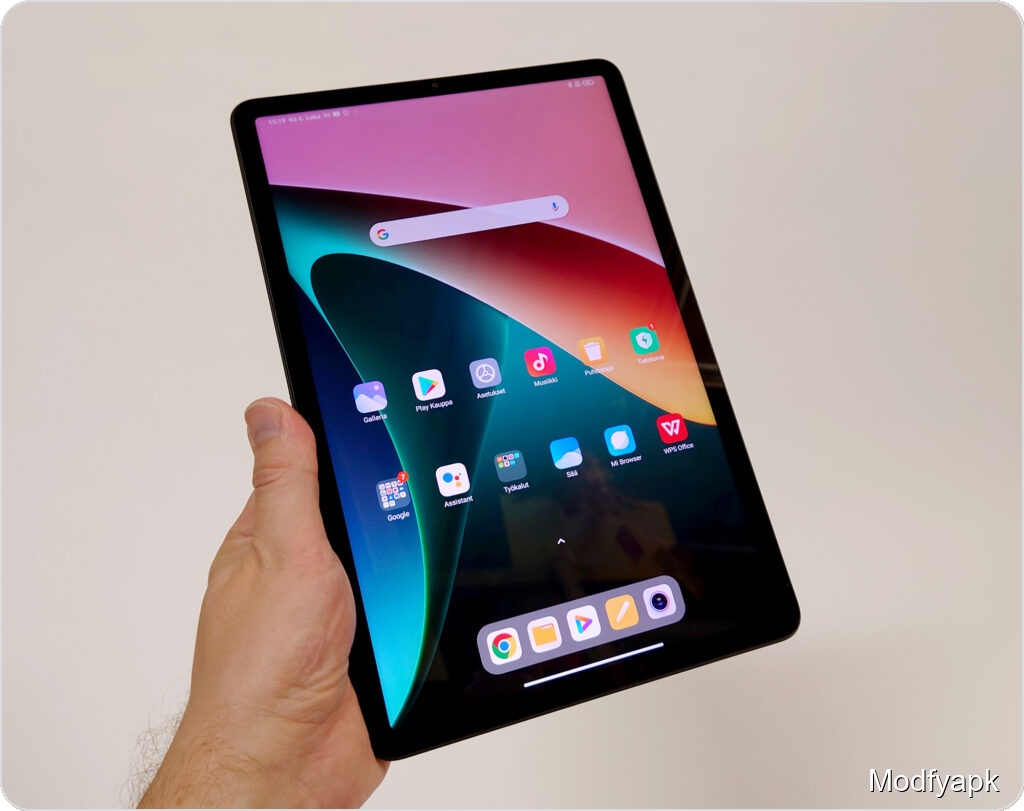
The Pad 5 is solidly built. The frame is stiff and resists twisting without any noticeable flex.
Display bezels measure around seven millimeters all the way around. That keeps fingers away from the active area without making the borders feel overbearing — a practical compromise.
The tablet’s edges are flat with a small chamfer toward the back and a slightly more pronounced step at the display. Handling is pleasant overall, though the 511 gram weight becomes apparent when holding the device one-handed with a corner resting in the palm. Two-handed use is much more comfortable. The thickness of about seven millimeters is acceptable; any more would start to feel bulky.
In portrait orientation the power button sits at the upper-right corner and the volume rocker at the upper part of the right edge. The USB-C port is on the bottom. There are four speakers total, two at the top and two at the bottom.
The Pad 5 lacks a fingerprint reader but supports face unlock. Face unlock is quick, especially in portrait use. In landscape orientation the front camera can be obscured by a finger, which prevents recognition. A fingerprint reader would be a more reliable option, so its omission is a curious choice.
Display
Rather than OLED, the Pad 5 uses an 11-inch IPS panel with a WQHD+ resolution of 2560 x 1600 pixels (about 275 ppi). The panel supports a 120 Hz refresh rate but defaults to 60 Hz and does not dynamically adapt refresh rate based on content.
The display supports Dolby Vision, which makes HDR content look very good. Brightness is sufficient for HDR playback and many brighter environments, although it is not exceptionally bright. The tablet also includes a True Display feature that subtly adjusts color reproduction based on ambient light. Overall, the screen is excellent for both media and productivity.
A notable annoyance is the automatic brightness control. It tends to fluctuate and often dims the panel too much, forcing manual intervention.
Audio
Unlike phones, the Pad 5 has four speakers and supports Dolby Atmos. The multi-driver setup widens the soundstage and prevents a single finger from blocking all output. The presentation emphasizes clarity and upper-mid detail, so vocals and treble are clean and easy to understand.
Stereo imaging in landscape is very good and Atmos-enabled content spills slightly around the tablet. As with most mobile devices, bass is limited. Volume is ample for a tablet of this class and the speakers remain relatively undistorted at higher levels.
Performance
Xiaomi equips the Pad 5 with a Qualcomm Snapdragon 860, a 7 nm, octa-core platform with a peak core clock of up to 2.96 GHz and an Adreno 640 GPU. Although the chipset debuted in 2019, it still delivers plenty of performance for daily tasks and virtually all mobile gaming.
To provide context, here are a few benchmark figures compared with two phones in roughly the same price or performance brackets:
Geekbench (single / multi core):
- Xiaomi Pad 5: 715 / 2756
- OnePlus Nord 2: 799 / 2593
- Xiaomi 11T Pro: 780 / 3188
PCMark:
- Xiaomi Pad 5: 11277
- OnePlus Nord 2: 8222
- Xiaomi 11T Pro: 13615
Antutu:
- Xiaomi Pad 5: 494971
- OnePlus Nord 2: 579364
- Xiaomi 11T Pro: 589879
The Pad 5 performs well for gaming and daily use. It sits ahead of the OnePlus Nord 2 in some workloads but behind the Snapdragon 888-equipped 11T Pro overall. Still, the gap is not severe for most real-world tasks.
Battery life and charging
The tablet houses an 8720 mAh battery. In practice it easily lasts a full day of mixed use. In a video playback loop test over Wi-Fi with the display on automatic brightness, the Pad 5 reached just under 20 hours.
Charging with the included charger takes a bit over two hours from empty to full. You get about 25 percent in the first 30 minutes and roughly 50 percent in an hour. Faster charging would be welcome, but this speed is workable.
Software
The Pad 5 runs MIUI 12.5 based on Android 11. Users coming from stock Android will need a short adjustment period, but the interface is not aggressively modified. Design language leans slightly rounded and soft while remaining restrained.
Notifications and the quick settings are split across separate gestures: swipe down on the right opens quick toggles, and swipe down on the left opens notifications. That takes getting used to. Settings are not directly reachable from the quick toggles unless you add a dedicated shortcut, which some may find frustrating. The app drawer is disabled by default but can be enabled in settings, as can gesture navigation.
The Pad 5 ships without an excessive amount of preinstalled apps; one notable bundled app is WPS Office, which some users may consider bloat.
Xiaomi has pledged three Android version upgrades and four years of security updates for its new 11T phones, but no equivalent promise has been made for the Pad 5. That lack of a clear update commitment is a downside, especially since tablets commonly have longer service lives.
Cameras
The Pad 5 uses a single 13 MP rear camera with autofocus. The approach of having one solid camera rather than multiple mediocre modules pays off. In good light the rear camera captures pleasing colors and fine detail, making it useful for notes and casual outdoor shots.
Low-light performance drops off. Automatic mode produces images that are too dark, while the available night mode smooths results and yields pleasant tones at the cost of some detail. The front camera is an 8 MP fixed-focus unit that handles selfies and video calls fine in bright conditions but becomes soft and noisy as light levels fall.
Limitations and omissions
The Pad 5 lacks a few conveniences that would broaden its use cases. Storage is not expandable via microSD, which can be restrictive if you want to download lots of offline media. There is no 3.5 mm headphone jack. Perhaps most surprisingly, the tablet does not include GPS, so it is unsuitable for any navigation or location-dependent uses.
Verdict
The Xiaomi Pad 5 is a well-built, media-focused tablet that offers strong value. Its WQHD+ Dolby Vision display, capable four-speaker Dolby Atmos setup, good real-world performance, and sturdy construction make it an excellent entertainment device. Cameras are serviceable, especially in good light, and battery life is strong.
Shortcomings include flaky automatic brightness, a lack of expandable storage and headphone jack, no fingerprint sensor, and no GPS. The unclear software update promise for tablets is also a concern.
For buyers focused on media consumption and general productivity who can live without those missing features, the Pad 5 delivers a compelling midrange package.
Pros and Cons
Good
- High-quality display
- Pleasant, powerful audio for a mobile device
- Enough performance for most tasks
- Sturdy, well-built chassis
Bad
- Edges can dig into your hand during extended one-handed use
- Automatic brightness behaves inconsistently
- No microSD slot or headphone jack